
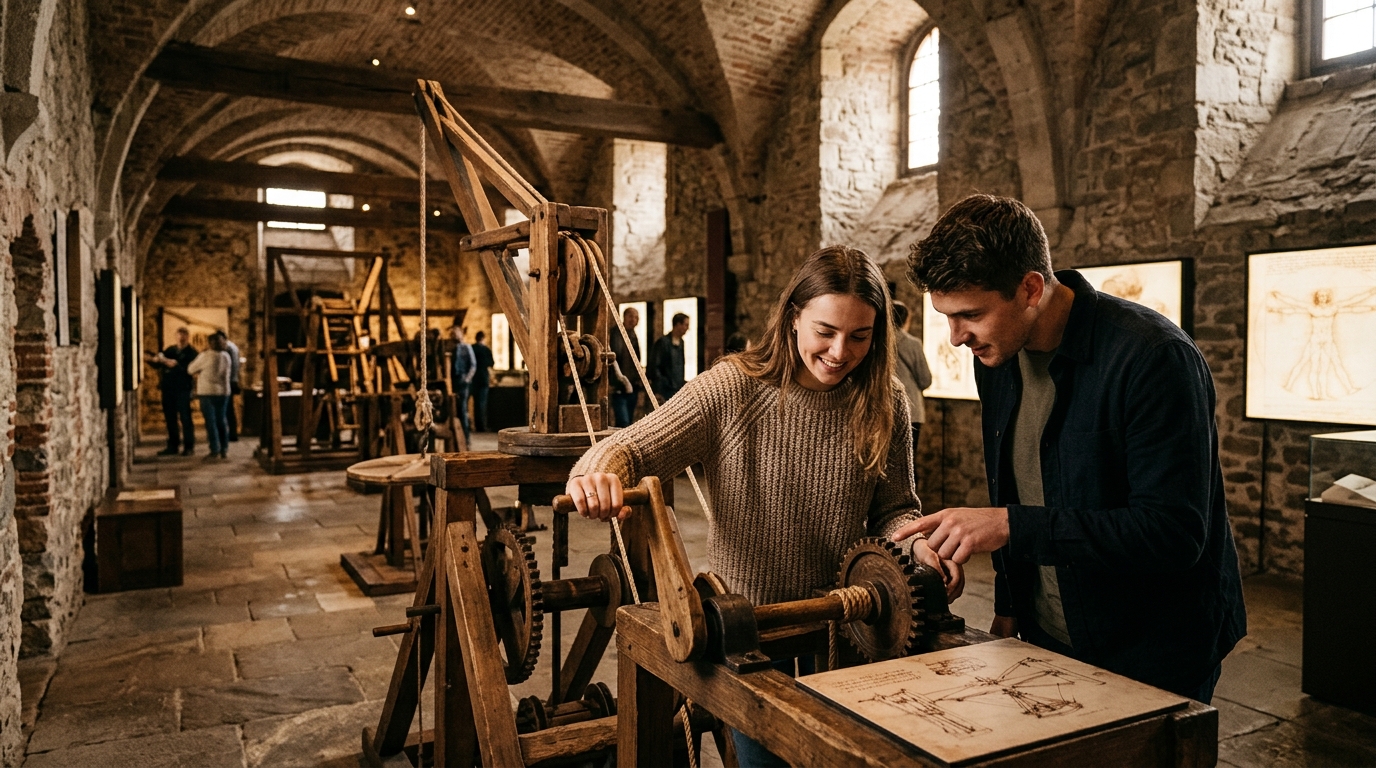
Leonardo da Vinci remains the ultimate symbol of the Renaissance mind, yet his physical legacy is scattered across Europe. According to recent tourism data, over 2 million visitors annually explore sites dedicated to his life and work, with a significant portion specifically seeking his mechanical designs. While the original manuscripts are rarely displayed in their entirety due to preservation needs, numerous institutions house working models, detailed replicas, and the actual codices that inspired modern engineering. This guide details exactly where you can witness these inventions firsthand. (Museo Leonardo da Vinci)
The Underground Vault in Rome
For travelers in Italy, the most accessible and immersive experience is located in the heart of Rome. The Museo Leonardo da Vinci in Piazza del Popolo offers a unique perspective on the genius's mechanical mind. Unlike traditional art museums, this venue focuses heavily on the intersection of art and engineering.
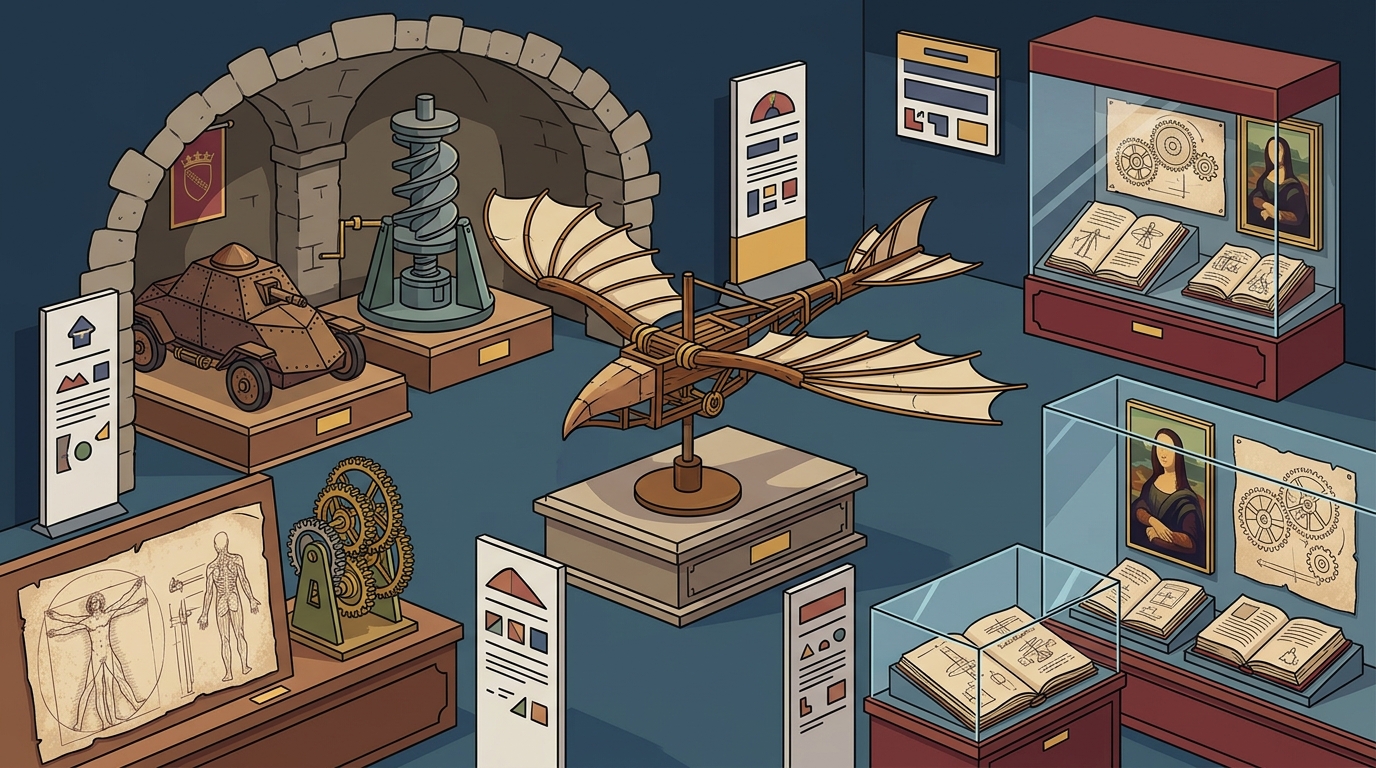
The museum is situated in the underground vaults of the Basilica Santa Maria del Popolo. This location is historically significant as it is one of the seven pilgrim churches in Rome. The space allows visitors to walk through detailed, life-sized models of Leonardo's flying machines, war tanks, and hydraulic pumps. These models are not static displays but are often designed to demonstrate the mechanical principles Leonardo originally sketched.
Visiting this site provides a tangible connection to his time in Rome, where he served under Pope Leo X. The museum highlights his anatomical studies alongside his mechanical inventions, showing how his understanding of human physiology influenced his engineering designs. It is widely considered the most popular dedicated Leonardo museum in Rome, making it a critical stop for any itinerary focused on his technical achievements.
For more information on current exhibitions and opening hours, you can visit the official info page of the museum.
Castles and Palaces in Milan
Milan was Leonardo's primary workplace for two decades, and the city retains the strongest physical evidence of his architectural and mechanical projects. The Sforza Castle, specifically the Sala delle Asse, houses the original frescoes painted by Leonardo himself. While not a machine, the room demonstrates his mastery of spatial design and illusion.
More importantly, the Castello Sforzesco frequently hosts temporary exhibitions featuring large-scale reconstructions of his inventions. These exhibitions often include working models of his helicopter, the aerial screw, and his parachute. The museum's collection is supported by extensive research into the Codex Atlanticus, the largest collection of Leonardo's writings.
Another key site in Milan is the Pinacoteca di Brera, which holds some of his earliest known drawings. These sketches provide the raw data for his later inventions. The city also features the Navigli district, where Leonardo's hydraulic engineering projects, including the canal locks and bridges, are still visible in modified forms today. His work on the Darsena, a massive port area, revolutionized Milan's trade infrastructure.
To explore the historical context of his time in Milan, you can read more about the gallery of his works and related historical artifacts.
Château de Clos Lucé in France
Leonardo spent his final three years in France under the patronage of King Francis I. The Château de Clos Lucé in Amboise is the only place in the world where you can walk through the actual rooms he inhabited while designing his most ambitious projects. This site is dedicated to the final chapter of his life and work.
The château features a massive park filled with full-scale, working models of Leonardo's inventions. These include the first helicopter, the tank, the multi-barreled gun, and the giant crossbow. The models are constructed based on his original notes and are fully functional, allowing visitors to see the mechanics in action. This is perhaps the most direct way to understand the practicality of his designs.
Inside the château, visitors can view the Codex Hammer, a collection of his scientific and technical notes. This manuscript contains detailed studies of flight, water flow, and anatomy. The site also includes a theater that screens documentaries about his life and the historical context of the French Renaissance. The proximity to the Château d'Amboise, where he is buried, adds a layer of historical gravity to the visit.
For international travelers, the official website of Château de Clos Lucé provides essential booking information and historical context.
Libraries Holding the Codices
While models are impressive, the original source material is the Codex Atlanticus, the Codex Leicester, and the Codex Arundel. These manuscripts are rarely displayed in their entirety due to their fragility. However, specific pages are occasionally exhibited in major museums worldwide.
The Biblioteca Trivulziana in Milan holds the Codex Trivulzianus, which contains some of his earliest mechanical designs. The Biblioteca Ambrosiana in Milan also holds a significant collection of his drawings, including the famous Codex Forster. These libraries are the primary repositories for his technical genius.
The Codex Leicester, currently owned by Bill Gates, is occasionally loaned to museums for special exhibitions. When on display, it offers a rare glimpse into his scientific mind. The British Library in London holds the Codex Arundel, which contains a wide range of topics from astronomy to geometry.
Understanding the provenance of these manuscripts is key to appreciating their value. The about page of the Rome museum provides excellent context on the historical significance of these documents.
Comparison of Key Locations
| Location | Primary Focus | Key Inventions Displayed | Best For |
|---|---|---|---|
| Museo Leonardo da Vinci, Rome | Interactive Models & Anatomy | Flying Machines, Hydraulic Pumps | First-time visitors in Italy |
| Château de Clos Lucé, France | Final Years & Full-Scale Models | Tank, Helicopter, Giant Crossbow | Engineering enthusiasts |
| Castello Sforzesco, Milan | Architectural & Artistic Legacy | Temporary Mechanical Exhibitions | History and Art lovers |
| Biblioteca Ambrosiana, Milan | Original Manuscripts | Codex Forster (Pages) | Academic researchers |
Key Takeaways
- The Museo Leonardo da Vinci in Rome is located in the underground vaults of Basilica Santa Maria del Popolo, offering a unique underground experience.
- Château de Clos Lucé in France features the largest collection of full-scale, working models of his inventions, including the helicopter and tank.
- Milan is the historical center of his mechanical work, with the Sforza Castle and Biblioteca Ambrosiana holding critical artifacts and manuscripts.
- Leonardo was anointed the master artist of Florence at the age of 18, which laid the foundation for his later engineering feats.
- The Codex Atlanticus is the largest collection of his writings, containing over 1,100 pages of drawings and notes.
- Visiting the Spanish Steps area in Rome allows for a combined cultural trip, as the museum is only a 5-minute walk from this landmark.
- Original manuscripts are rarely displayed due to light sensitivity, so models and replicas are the primary way to see his inventions in person.
Frequently Asked Questions
Can I see the original Mona Lisa in these museums?
No, the original Mona Lisa is housed exclusively in the Louvre Museum in Paris. The museums dedicated to Leonardo's inventions focus on his mechanical and scientific work, not his finished paintings.
Is the Museo Leonardo da Vinci in Rome open to the public?
Yes, the museum is open to the public and is located at the end of Via del Corso. It is accessible to all visitors interested in his life and work.
What is the best time to visit the Château de Clos Lucé?
The spring and summer months are the most popular times to visit. However, the park with the working models is particularly beautiful in the spring when the gardens are in bloom.
Are the models at the Rome museum interactive?
Yes, the museum features an interactive world where visitors can explore Leonardo's passions. Many models are designed to demonstrate the mechanical principles behind his designs.
How long does it take to tour the museum in Rome?
A typical visit to the Museo Leonardo da Vinci in Piazza del Popolo takes about 1 to 2 hours, depending on your interest in the detailed exhibits.
Where is Leonardo da Vinci buried?
He is buried in the Chapel of Saint-Hubert at the Château d'Amboise in France, near the Château de Clos Lucé.
Do I need to book tickets in advance?
It is highly recommended to book tickets in advance, especially during peak tourist seasons. You can check availability on the official info page.
Plan Your Visit
Witnessing Leonardo da Vinci's inventions in person is a profound experience that bridges the gap between historical art and modern engineering. Whether you choose the underground vaults of Rome, the working models of France, or the manuscripts of Milan, each location offers a unique perspective on his genius. To ensure a seamless experience, we recommend planning your itinerary around the specific collections you wish to see.
For immediate booking and detailed visitor information, please visit the official website of Museo Leonardo da Vinci. You can also contact them directly at info@museodavinci.it or +39 06 3200144 for any specific inquiries regarding group tours or accessibility.