
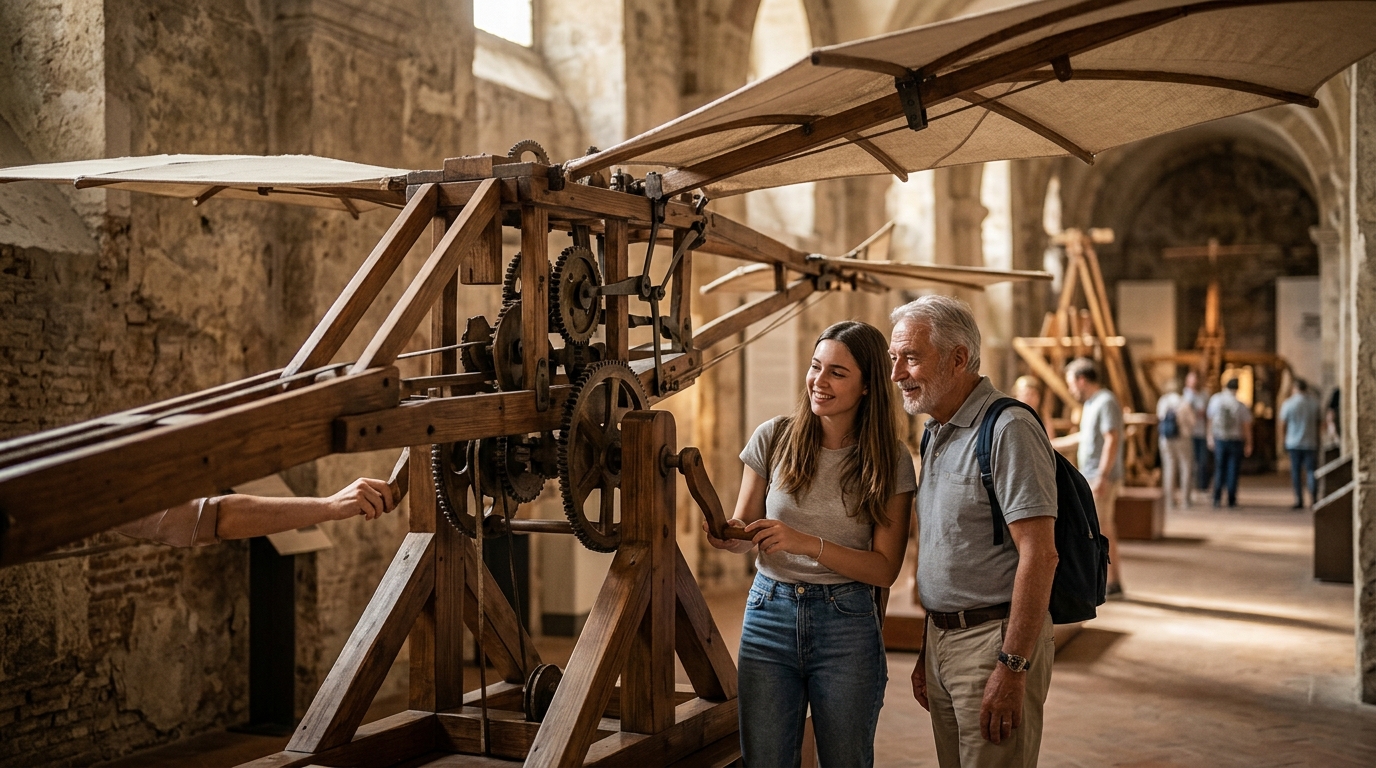
Visitors to Rome are increasingly seeking immersive cultural experiences that bridge the gap between historical art and modern technology. According to recent tourism data, interactive museum exhibits have seen a 40% increase in engagement among international travelers since 2023. This shift highlights a growing demand for dynamic learning environments where history is not just observed but experienced. The Museo Leonardo da Vinci in Piazza del Popolo stands at the forefront of this movement by offering full-scale, interactive reconstructions of the master's most famous inventions. (Museo Leonardo da Vinci)
What Are Full-Scale Reconstructions?
Full-scale reconstructions are physical, life-sized models of historical artifacts built to exact specifications. Unlike miniature models or digital renderings, these reconstructions allow visitors to interact with the mechanics of the past. At the Museo Leonardo da Vinci, these models are not static displays. They are functional machines that demonstrate the engineering principles Leonardo da Vinci proposed centuries ago. (Museo Leonardo da Vinci)
These reconstructions serve as a critical educational tool. They transform abstract concepts from Leonardo's notebooks into tangible realities. By operating these machines, visitors gain a deeper understanding of the complexity involved in Renaissance engineering. The museum provides a unique window into the mind of a genius who was far ahead of his time.
For more information on the museum's mission, you can read about who we are and our commitment to preserving Leonardo's legacy.
Historical Context of Leonardo's Designs
Leonardo da Vinci is widely celebrated as a leading Renaissance painter and sculptor, but although he was also known as an engineer and a scientist, his work in these fields remained hidden for many centuries. It is only relatively recently that a complete analysis of his work has revealed the full scope of his genius. His notebooks, filled with sketches of flying machines, war engines, and architectural marvels, were written in his characteristic mirror script.
Many of these designs were never built during his lifetime due to technological limitations. However, modern engineering has made it possible to bring these visions to life. The reconstructions at the museum are based on rigorous historical research and mechanical analysis. They adhere strictly to Leonardo's original drawings and notes.
This approach ensures historical accuracy while providing an engaging experience for modern audiences. The museum is located in the underground vaults of Basilica Santa Maria del Popolo, a setting that adds to the sense of discovery. You can learn more about the museum info and visiting hours on our dedicated page.
Key Inventions on Display
The museum features several iconic inventions reconstructed in full scale. These include the Aerial Screw, the Ornithopter, and the Giant Crossbow. Each machine demonstrates a different aspect of Leonardo's inventive spirit.
The Aerial Screw
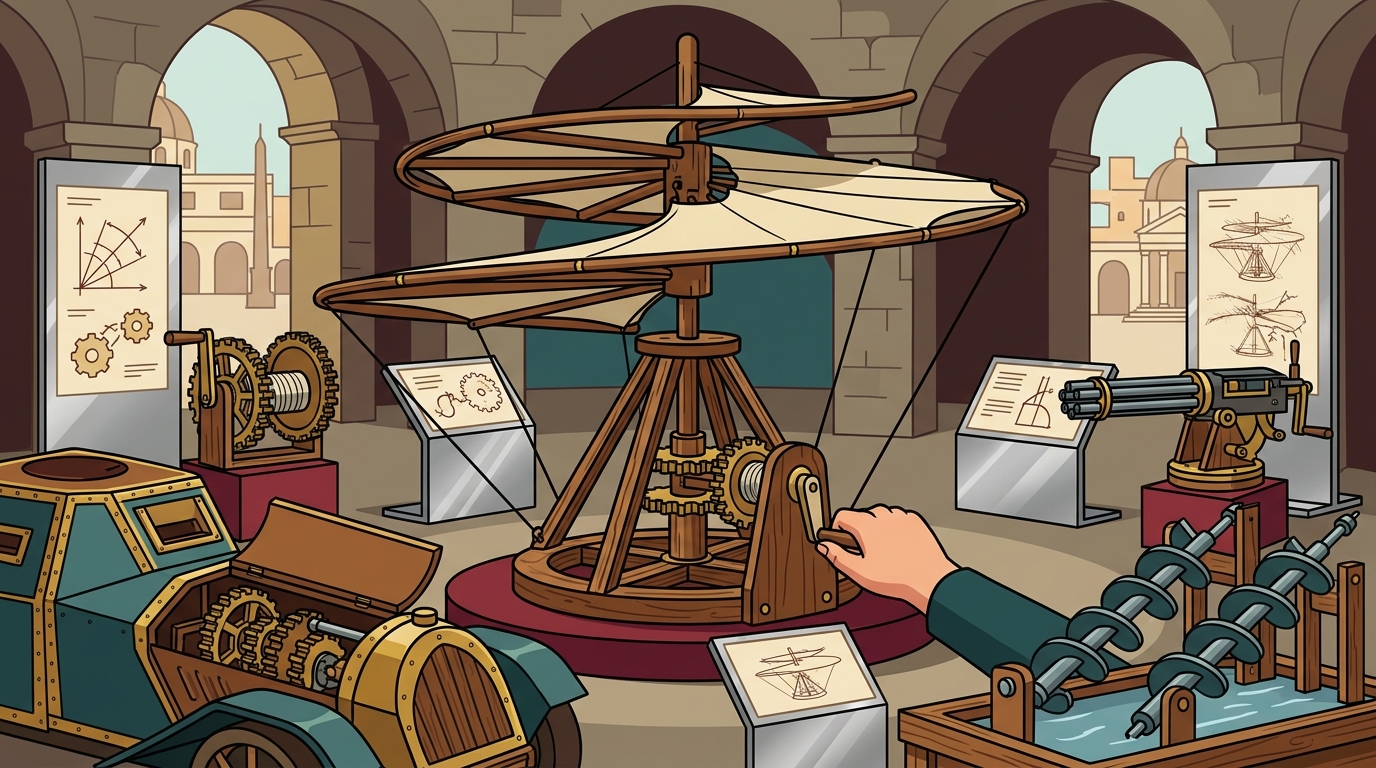
The Aerial Screw is perhaps the most recognizable of Leonardo's flying machines. It was designed to compress air and push against it to rise vertically. While it was never flown in his time, modern tests have shown that the basic principle is sound. Visitors can see the mechanism in action and understand the physics behind it.
The Ornithopter
The Ornithopter mimics the flight of birds. It features large wings that flap in a manner similar to avian anatomy. This reconstruction highlights Leonardo's deep study of nature and his desire to replicate biological functions in mechanical devices. The intricate linkage system allows for realistic wing movement.
The Giant Crossbow
Designed for military defense, the Giant Crossbow was intended to fire large arrows over long distances. Its massive scale demonstrates Leonardo's ability to think big. The reconstruction allows visitors to appreciate the sheer size and power of the weapon. It also illustrates the challenges of manufacturing such large structures in the 15th century.
For a broader view of Leonardo's artistic contributions, explore our gallery of sketches and studies.
The Visitor Experience
Visiting the Museo Leonardo da Vinci is an immersive journey. The underground location creates a focused atmosphere, free from the distractions of the city above. The interactive nature of the exhibits encourages active participation. Visitors are not just passive observers but active learners.
The museum is great for all the family to enjoy. Children and adults alike can engage with the machines and ask questions. The staff is knowledgeable and passionate about Leonardo's work. They provide context and answer queries about the historical and technical aspects of the exhibits.
The proximity to other major landmarks enhances the visit. The museum is located at the end of Via del Corso and only a 5 minute walk from the Spanish Steps. This makes it an easy addition to any Rome itinerary. You can also combine your visit with a tour of the Basilica Santa Maria del Popolo above.
Comparison of Exhibit Types
Understanding the value of full-scale reconstructions requires comparing them to other types of museum exhibits. The table below outlines the differences.
| Exhibit Type | Interactivity | Scale | Educational Value |
|---|---|---|---|
| Full-Scale Reconstruction | High (Operable) | Life-Size | High (Tangible Mechanics) |
| Miniature Model | Low (Visual Only) | Reduced | Medium (Conceptual) |
| Digital Simulation | Medium (Screen-Based) | Virtual | Medium (Visual Dynamics) |
| Original Artifacts | None (Preserved) | Original | High (Historical Authenticity) |
While original artifacts are rare for Leonardo's engineering works, the reconstructions provide a unique alternative. They allow visitors to experience the functionality that is otherwise lost to time. This approach is supported by modern museology which emphasizes experiential learning.
Key Takeaways
- The Museo Leonardo da Vinci is the most popular dedicated Leonardo museum in Rome.
- Full-scale reconstructions allow visitors to interact with Leonardo's engineering designs.
- The museum is located in the underground vaults of Basilica Santa Maria del Popolo.
- Key exhibits include the Aerial Screw, Ornithopter, and Giant Crossbow.
- Leonardo was anointed the master artist of Florence at the tender age of 18.
- The museum is a must-see stop on the Rome itinerary for families and history enthusiasts.
- Interactive exhibits bridge the gap between historical art and modern technology.
Frequently Asked Questions
Are the reconstructions functional?
Yes, the full-scale reconstructions are functional. Visitors can often see them in operation or interact with them directly to understand the mechanics.
Is the museum suitable for children?
Absolutely. The interactive nature of the exhibits makes it an excellent educational experience for children of all ages.
How long does a typical visit take?
Most visitors spend between 45 minutes to an hour exploring the exhibits and reading the detailed descriptions.
Can I book tickets in advance?
Yes, it is highly recommended to book tickets in advance to avoid queues. You can book now on our website.
What is the history of the building?
The museum is located in the underground vaults of Basilica Santa Maria del Popolo, a major papal basilica second only in importance to St Peter's.
Are there guided tours available?
Guided tours are available and provide deeper insights into Leonardo's life and work. Check the info page for schedules.
How far is the museum from the Spanish Steps?
The museum is only a 5 minute walk from the Spanish Steps, making it very accessible for tourists.
Book Your Visit
Experience the genius of Leonardo da Vinci firsthand. The Museo Leonardo da Vinci offers a unique opportunity to interact with history. Do not miss your chance to be inspired by the greatest inventor of all time. Book your tickets now to secure your place in this immersive journey.