
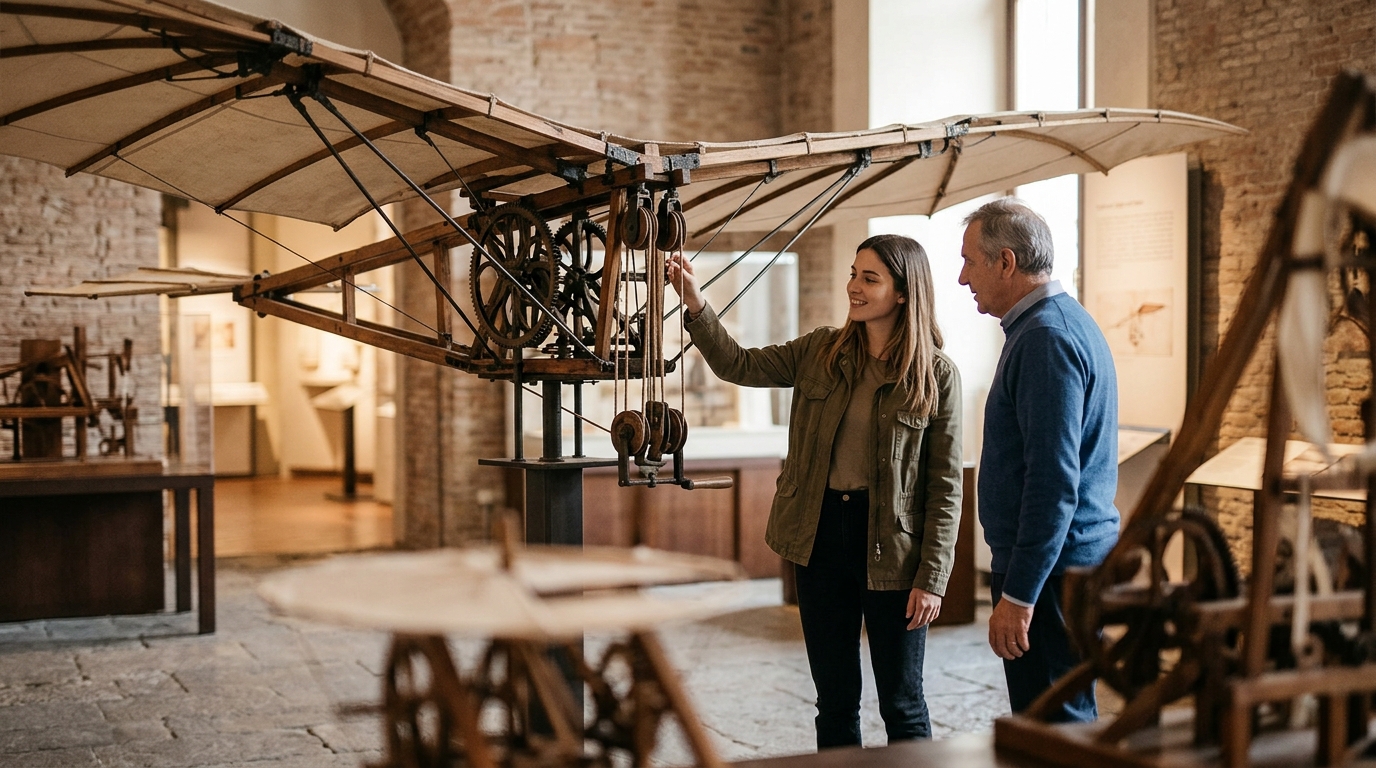
Leonardo da Vinci is widely celebrated as a leading Renaissance painter and sculptor, but although he was also known as an engineer and a scientist, his work in these fields remained hidden for many centuries. It is only relatively recently that a complete analysis of his work has revealed the full scope of his genius. He truly was one of the greatest inventors, artists, scientists and thinkers of all time. Today, you can witness the mechanical brilliance that defined his legacy through interactive models and original manuscripts located in major cultural hubs across Europe. (Museo Leonardo da Vinci)
Rome: The Interactive Vault Experience
For travelers seeking a dynamic, immersive encounter with the inventor's mind, Rome offers a unique opportunity. The Museo Leonardo da Vinci in Piazza del Popolo provides a dedicated space to explore his passions and studies in the underground vaults of Basilica Santa Maria del Popolo. This location is particularly significant because it combines historical architecture with modern educational technology.
While you won't see the original artworks like the Mona Lisa at this museum, you will discover his incredible story, groundbreaking inventions, detailed anatomical sketches, startling scientific discoveries and much more. The museum features large-scale, functional models of his machines, including flying machines, war engines, and hydraulic pumps. These are not static displays but working replicas that demonstrate the engineering principles Leonardo proposed five hundred years ago.
The museum is the most popular dedicated Leonardo museum in Rome. It is great for all the family to enjoy and a must-see stop on the Rome itinerary. Visitors can walk through the interactive world of Leonardo's studies, gaining a tangible understanding of how his theoretical sketches translated into mechanical reality. The location is situated at the end of Via del Corso and is only a 5 minute walk from the Spanish Steps, making it easily accessible for tourists exploring the historic center.
Combining your visit to this museum with the surrounding area enhances the historical context. You can explore the incredible historic and stunning Basilica Santa Maria del Popolo, which houses original Caravaggio paintings from the 1600s and the magnificent Chigi Chapel, built and decorated by the legendary Raphael. Santa Maria is the burial site of 6 popes, adding a layer of ecclesiastical history to your educational journey.
Paris: The Codex Royal Collection
If your goal is to view the actual handwritten notes and original sketches, Paris is the primary destination. The Bibliothèque nationale de France holds the largest collection of Leonardo's manuscripts in the world, known as the Codex Royal. This collection includes the Codex Forster, Codex Leicester, and others that were acquired by King Francis I of France.
According to historical records, King Francis I invited Leonardo to France in 1516, where he spent his final years. During this period, Leonardo continued to refine his designs for flying machines and architectural projects. The manuscripts in Paris provide the raw data of his genius, showing the evolution of his ideas from initial sketch to detailed engineering plan.
Visiting the Bibliothèque nationale de France allows you to see the original ink drawings that inspired the models seen in museums worldwide. The collection is periodically rotated, so checking the current exhibition schedule is essential. The manuscripts cover a wide range of topics, from the anatomy of the heart to the design of a giant crossbow. This is the definitive source for scholars and serious enthusiasts who want to study the primary evidence of Leonardo's inventive process.
Turin: The Royal Manuscripts
Turin, the capital of the Piedmont region in Italy, holds another critical piece of the Leonardo puzzle. The Royal Library of Turin (Biblioteca Reale) houses the Codex Forster and other significant manuscripts. These documents were part of the Savoy family collection, which inherited many of Leonardo's works after his death in France.
The Codex Forster is particularly notable for its detailed studies of water flow and hydraulic engineering. Leonardo's fascination with water was not just scientific but also aesthetic. He observed the turbulence of rivers and the movement of waves, translating these natural phenomena into mechanical designs. The manuscripts in Turin offer a glimpse into this specific interest, providing technical drawings that were ahead of their time by centuries.
The Royal Library also hosts temporary exhibitions that focus on Leonardo's scientific work. These exhibitions often feature high-resolution reproductions of the manuscripts alongside functional models. This combination helps visitors understand the scale and complexity of Leonardo's inventions. The library's collection is one of the most important in the world, rivaling the holdings in Paris and Milan.
Milan: The Codex Atlanticus
Milan, where Leonardo spent a significant portion of his career, is home to the Codex Atlanticus. This is the largest collection of Leonardo's writings and drawings, comprising 1,119 pages. It is housed in the Biblioteca Ambrosiana and is one of the most valuable cultural assets in Italy.
The Codex Atlanticus covers a vast array of subjects, including geometry, mechanics, astronomy, and botany. It provides a comprehensive overview of Leonardo's intellectual curiosity. The manuscript was compiled by Pompeo Leoni, a sculptor who bound together various loose sheets of Leonardo's work. This binding process preserved the documents but also mixed them up, making the study of the Codex a complex but rewarding task for researchers.
Visiting the Biblioteca Ambrosiana allows you to see the original pages of the Codex Atlanticus. The library regularly displays sections of the manuscript, allowing visitors to view the intricate details of Leonardo's drawings. The Codex includes designs for flying machines, military fortifications, and urban planning projects. It is a testament to Leonardo's ability to think across multiple disciplines simultaneously.
Amboise: The Château Legacy
For those interested in the final chapter of Leonardo's life, the Château de Clos Lucé in Amboise, France, is the essential destination. Leonardo spent his last three years here, under the patronage of King Francis I. The château now houses a museum dedicated to his life and work.
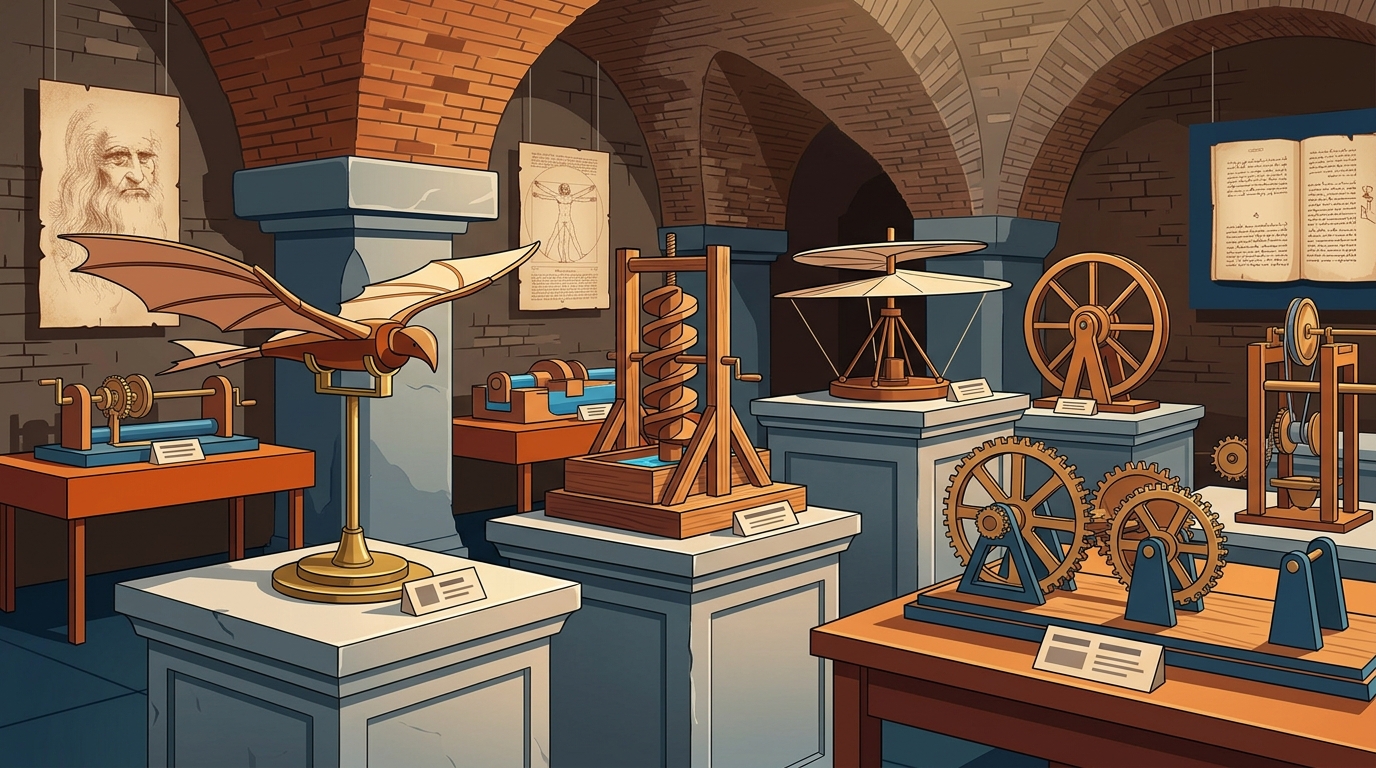
The museum features large-scale models of Leonardo's inventions, including the helical air screw, which is considered a precursor to the modern helicopter. These models are built according to Leonardo's original specifications and are fully functional. Visitors can see how the mechanical principles he designed in his notebooks can be applied in the real world.
The grounds of the Château de Clos Lucé also include a garden with additional models of Leonardo's machines. This outdoor setting provides a unique perspective on how his inventions might have interacted with the natural environment. The château is located near the Château d'Amboise, where Leonardo is buried. This connection between his life, work, and final resting place makes Amboise a poignant destination for fans of the Renaissance polymath.
Comparison of Key Locations
| Location | Primary Asset | Experience Type | Best For |
|---|---|---|---|
| Rome (Museo Leonardo da Vinci) | Interactive Models | Immersive & Family-Friendly | Visual learners & tourists |
| Paris (BnF) | Codex Royal Manuscripts | Archival & Scholarly | Researchers & historians |
| Turin (Biblioteca Reale) | Codex Forster | Academic & Technical | Engineering enthusiasts |
| Milan (Biblioteca Ambrosiana) | Codex Atlanticus | Historical & Comprehensive | Deep dive into his work |
| Amboise (Château de Clos Lucé) | Functional Replicas | Experiential & Historical | Family & legacy seekers |
Key Takeaways
- Rome's Museo Leonardo da Vinci offers the most accessible interactive experience, located in the underground vaults of Basilica Santa Maria del Popolo.
- Paris holds the largest collection of original manuscripts, including the Codex Royal, acquired by King Francis I.
- Turin's Biblioteca Reale houses the Codex Forster, focusing on hydraulic engineering and water studies.
- Milan's Biblioteca Ambrosiana contains the Codex Atlanticus, the largest single collection of his writings.
- Amboise's Château de Clos Lucé features functional models of his inventions and is his final resting place.
- Leonardo was anointed the master artist of Florence at the tender age of 18, laying the groundwork for his later scientific inquiries.
- The museum in Rome is the most popular dedicated Leonardo museum in the city, making it a high-priority stop for visitors.
Frequently Asked Questions
Can I see the original Mona Lisa in these museums?
No, the original Mona Lisa is housed in the Louvre Museum in Paris. The museums listed here focus on Leonardo's scientific and engineering work, not his paintings. While you will see sketches and studies related to his art, the iconic paintings are kept in separate, high-security locations.
Is the Museo Leonardo da Vinci in Rome open to the public?
Yes, the Museo Leonardo da Vinci in Piazza del Popolo is open to the public. It is located in the underground vaults of Basilica Santa Maria del Popolo. Visitors can book tickets in advance to ensure entry, especially during peak tourist seasons.
Which museum has the best models of Leonardo's flying machines?
The Château de Clos Lucé in Amboise and the Museo Leonardo da Vinci in Rome both feature excellent models of Leonardo's flying machines. The models in Amboise are built to scale and are fully functional, demonstrating the aerodynamic principles Leonardo proposed.
Are the manuscripts in Paris and Milan accessible to visitors?
Yes, the manuscripts in Paris (Bibliothèque nationale de France) and Milan (Biblioteca Ambrosiana) are accessible to visitors. However, due to their fragility, they are often displayed in limited rotations. It is advisable to check the current exhibition schedules before planning your visit.
How long does it take to visit the Museo Leonardo da Vinci in Rome?
A typical visit to the Museo Leonardo da Vinci in Rome takes about one to two hours. The interactive exhibits allow visitors to spend time exploring the different rooms and understanding the context of each invention.
Is the museum in Rome suitable for children?
Yes, the museum is great for all the family to enjoy. The interactive nature of the exhibits, including working models and engaging displays, makes it an educational and entertaining experience for children and adults alike.
What is the Codex Atlanticus?
The Codex Atlanticus is the largest collection of Leonardo's writings and drawings, comprising 1,119 pages. It is housed in the Biblioteca Ambrosiana in Milan and covers a wide range of subjects, from geometry to botany.
Plan Your Visit
Discover the greatest genius of all time in the heart of Rome. The Museo Leonardo da Vinci in Piazza del Popolo offers a unique opportunity to see his inventions in person. Book your tickets today to immerse yourself in an interactive world of Leonardo's passions and studies. Visit the official website to learn more about opening hours and ticket options.