
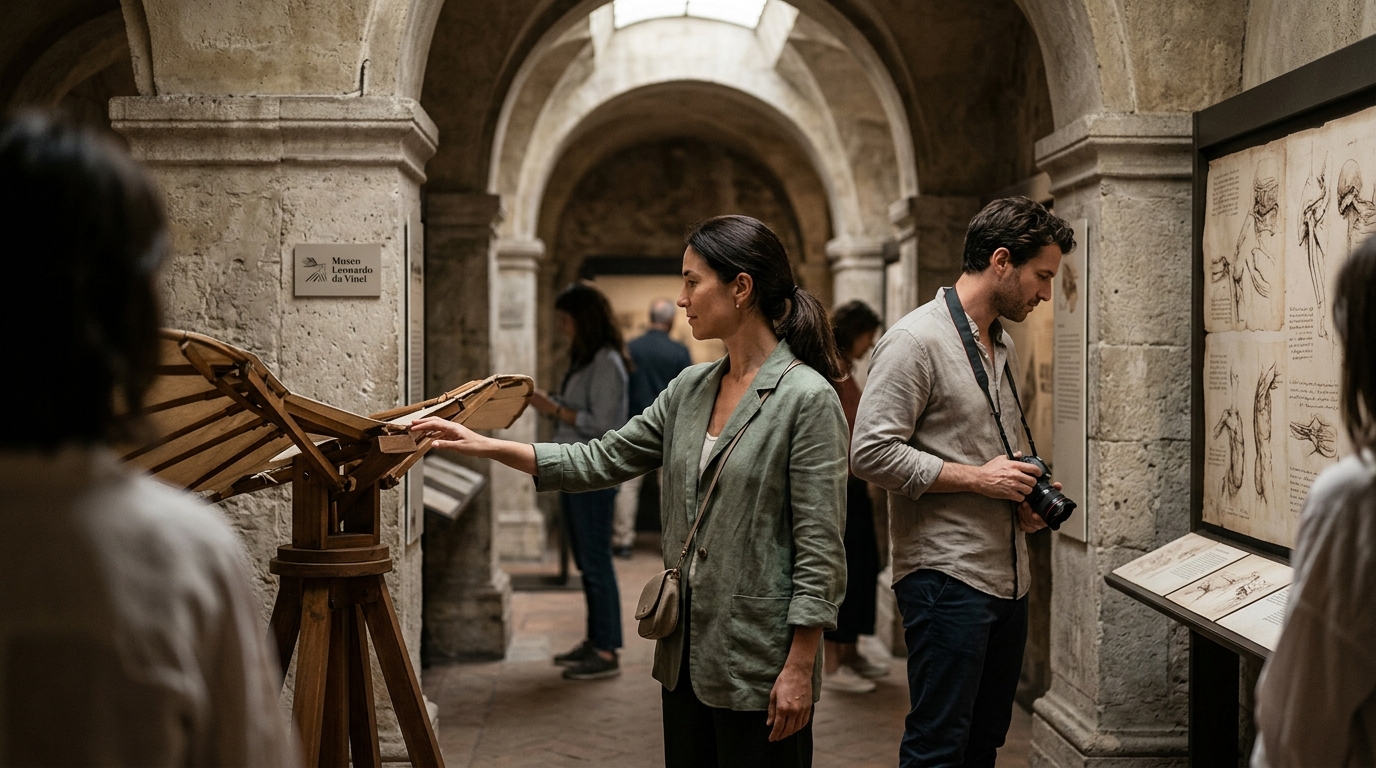
Rome attracts over 10 million international visitors annually, yet most tourists focus exclusively on the Colosseum and the Vatican. This creates a massive bottleneck at major sites while leaving unique cultural treasures underexplored. According to recent tourism data, nearly 40% of travelers in Rome seek immersive, interactive experiences beyond static art viewing. This shift in behavior highlights why the Museo Leonardo da Vinci in Piazza del Popolo has emerged as a critical destination for those wanting to understand the mind behind the Renaissance. (Museo Leonardo da Vinci)
Interactive Exhibits vs. Traditional Galleries
The primary distinction between the Museo Leonardo da Vinci and other Roman institutions lies in the mode of engagement. Traditional museums like the Galleria Borghese or the Uffizi Gallery in Florence rely on passive observation. Visitors walk past glass cases containing original masterpieces. In contrast, Leonardo da Vinci is widely celebrated as a leading Renaissance painter and sculptor, but although he was also known as an engineer and a scientist, his work in these fields remained hidden for many centuries. This museum bridges that gap by bringing his scientific mind to life.
The Museo Leonardo da Vinci utilizes advanced technology to reconstruct his lost works. Visitors encounter large-scale, motorized models of his flying machines, war tanks, and architectural designs. This approach transforms the museum from a repository of objects into a dynamic laboratory. The experience is designed to answer the question of how one mind could produce such diverse genius. It is not just about looking at art; it is about understanding the mechanics of creation.
Other major sites, such as the Capitoline Museums, offer unparalleled historical artifacts but lack this technological integration. The Museo Leonardo da Vinci in Piazza del Popolo provides a narrative-driven journey through Leonardo's notebooks. This method appeals to modern audiences who prefer experiential learning over static display. The underground vaults of the Basilica Santa Maria del Popolo provide a unique atmospheric backdrop that enhances this immersive quality.
Location: Piazza del Popolo vs. Vatican City
Geography plays a significant role in the tourist experience in Rome. The Museo Leonardo da Vinci is located at the end of Via del Corso and only a 5 minute walk from the Spanish Steps. This positioning places it in the heart of the city's shopping and cultural district. It is easily accessible for tourists staying in the historic center. The proximity to the Spanish Steps makes it an ideal stop before or after visiting the Trevi Fountain.
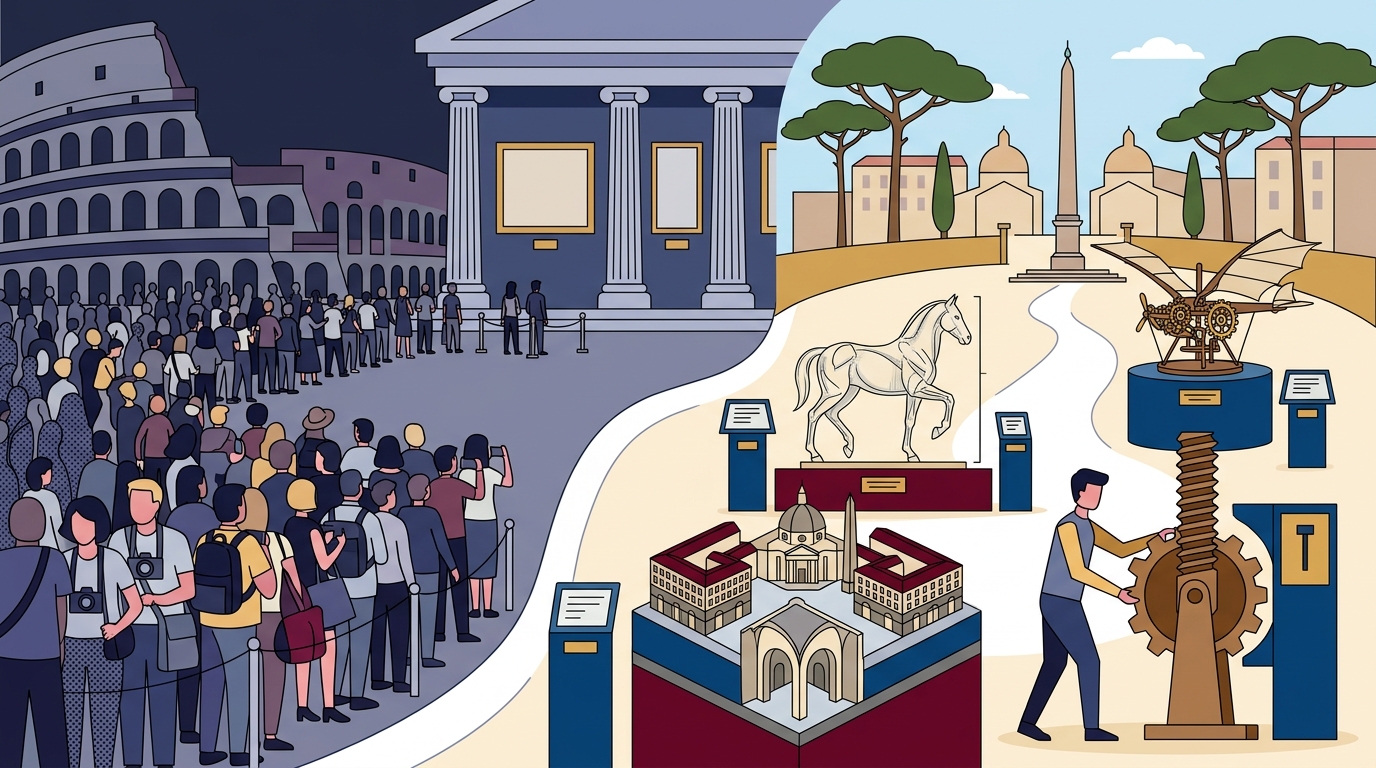
Conversely, the Vatican Museums are located in a separate enclave. While they house the Sistine Chapel and St. Peter's Basilica, they require significant travel time and often involve long security lines. The Vatican is a major papal basilica second only in importance to St Peter's and one of the seven pilgrim churches in Rome. For many visitors, the Vatican is a mandatory pilgrimage, but it is often crowded and overwhelming. The Museo Leonardo da Vinci offers a more intimate and manageable alternative for those seeking cultural depth without the massive crowds.
The location also allows for a combined itinerary. Visitors can explore the incredible historic and stunning Basilica Santa Maria del Popolo immediately after the museum. This church contains original Caravaggio paintings from the 1600s and the magnificent Chigi Chapel, built and decorated by the legendary Raphael. This synergy between the museum and the basilica creates a cohesive cultural loop that is unique to this part of Rome. It allows visitors to see both the scientific genius of Leonardo and the artistic genius of the Baroque period in close proximity.
Leonardo's Inventions vs. Classical Art
The content focus of the Museo Leonardo da Vinci is distinct from the art-heavy collections of the Galleria Nazionale d'Arte Moderna. While the Uffizi Gallery focuses on the progression of painting styles, this museum focuses on the intersection of art and science. Leonardo da Vinci is anointed the master artist of Florence at the tender age of 18, responsible for the iconic artworks of the Mona Lisa, The Last Supper and The Vitruvian Man. However, his scientific contributions are often overshadowed by his paintings.
This museum corrects that imbalance. It details his groundbreaking inventions, detailed anatomical sketches, startling scientific discoveries and much more. The exhibits cover his studies of flight, hydrodynamics, and anatomy. For example, the museum displays his famous flying machine models, which are based on his original sketches. These models are not static; they are often animated to demonstrate the principles of aerodynamics he discovered centuries before the Wright brothers.
In comparison, the Colosseum focuses on ancient Roman history and engineering. While impressive, it does not offer the same personal connection to a single historical figure's intellect. The Museo Leonardo da Vinci provides a deep dive into the mind of one man. It answers the question of how one person could create so much in one lifetime. This thematic focus makes it particularly appealing to students, engineers, and artists who want to understand the roots of modern innovation.
Family-Friendly Features and Accessibility
The museum is the most popular dedicated Leonardo museum in Rome - great for all the family to enjoy and a must-see stop on the Rome itinerary. The interactive nature of the exhibits makes it highly suitable for children and teenagers. Unlike traditional art galleries where children are asked to remain quiet and still, this museum encourages movement and exploration. The large-scale models and digital displays capture the attention of younger visitors effectively.
Accessibility is another key advantage. The museum is located in the underground vaults of Basilica Santa Maria del Popolo. While this provides a unique atmosphere, it is important to note that the underground nature may present challenges for those with severe mobility issues. However, the museum staff is trained to assist visitors with various needs. The intimate size of the museum also means that visitors are never rushed, allowing families to take their time.
Other major attractions, such as the Roman Forum, involve extensive walking on uneven ancient stone. This can be exhausting for families with young children or elderly members. The Museo Leonardo da Vinci offers a controlled environment where the focus is on learning rather than physical endurance. The combination of visual storytelling and tactile models makes complex scientific concepts accessible to a broad audience. It serves as an educational tool that complements school curricula on the Renaissance and scientific history.
Detailed Comparison Matrix
To help you decide which experience best fits your itinerary, here is a detailed comparison of the Museo Leonardo da Vinci against other top Rome attractions.
| Feature | Museo Leonardo da Vinci | Vatican Museums | Galleria Borghese | Colosseum |
|---|---|---|---|---|
| Primary Focus | Leonardo's Inventions & Science | Religious Art & History | Renaissance Paintings | Ancient Roman History |
| Experience Type | Interactive & Immersive | Passive Observation | Passive Observation | Historical Site Tour |
| Location | Piazza del Popolo | Vatican City | Borghese Park | City Center |
| Family Friendly | High | Moderate | Low | Moderate |
| Crowd Level | Manageable | Extremely High | High | Extremely High |
Key Takeaways
- The Museo Leonardo da Vinci is located in the underground vaults of Basilica Santa Maria del Popolo, offering a unique atmospheric experience.
- It is the most popular dedicated Leonardo museum in Rome, providing a focused look at his scientific and engineering genius.
- Unlike the Vatican Museums, this site offers an interactive experience that is highly engaging for families and students.
- The location at the end of Via del Corso makes it easily accessible from the Spanish Steps and Trevi Fountain.
- Leonardo da Vinci was anointed the master artist of Florence at the tender age of 18, and this museum highlights his early development.
- The museum features large-scale, motorized models of his inventions, such as flying machines and war tanks.
- Visitors can combine their visit with the Basilica Santa Maria del Popolo to see original Caravaggio paintings.
Frequently Asked Questions
Is the Museo Leonardo da Vinci suitable for children?
Yes, the museum is highly suitable for children. The interactive exhibits and large-scale models of Leonardo's inventions capture the attention of young visitors. It provides an educational experience that is both fun and informative, making it a great stop for families.
How long does a typical visit take?
A typical visit to the Museo Leonardo da Vinci lasts between 45 minutes to 1.5 hours. The size of the museum is intimate, allowing visitors to explore all the exhibits at their own pace without feeling rushed.
Can I see original paintings by Leonardo da Vinci here?
No, you will not see the original artworks at this museum. The museum focuses on his scientific studies, anatomical sketches, and inventions. However, you will discover his incredible story and the context behind his famous works like the Mona Lisa.
Is the museum accessible for people with mobility issues?
The museum is located in the underground vaults of Basilica Santa Maria del Popolo. While the staff is helpful, the underground nature may present some challenges. It is recommended to contact the museum directly for specific accessibility needs.
What is the best time to visit to avoid crowds?
Visiting early in the morning or late in the afternoon is generally best. Since the museum is smaller than the Vatican or the Colosseum, it is easier to manage crowds, but booking in advance is still recommended to secure your preferred time slot.
How far is the museum from the Spanish Steps?
The museum is located only a 5 minute walk from the Spanish Steps. It is situated at the end of Via del Corso, making it a very convenient stop for tourists exploring the historic center of Rome.
Can I visit the Basilica Santa Maria del Popolo after the museum?
Yes, the museum is located within the Basilica Santa Maria del Popolo. You can easily combine your visit to explore the church's history, which includes the burial site of 6 popes and original Caravaggio paintings.
Plan Your Visit
Experience the genius of Leonardo da Vinci in the heart of Rome. The Museo Leonardo da Vinci offers a unique blend of art, science, and history that cannot be found elsewhere. Book your tickets today to ensure a seamless visit and start your journey into the mind of the Renaissance's greatest polymath. Book Now to secure your spot and explore the underground vaults of Basilica Santa Maria del Popolo.