
Essential Features and Design Standards of Interactive Museum Exhibits at Piazza del Popolo
Museo Leonardo da Vinci in Piazza del Popolo has established itself as a premier destination for cultural tourism in Rome by leveraging advanced interactive technologies within its underground vaults. Located at the end of Via del Corso, this institution transforms the legacy of the Renaissance polymath into a tangible, immersive experience for modern visitors. The museum's approach to exhibit design prioritizes high-fidelity digital reconstruction and tactile engagement, ensuring that the complex scientific and artistic achievements of Leonardo are accessible to a global audience. This guide analyzes the core design standards and interactive features that define the visitor journey at this unique cultural site. (Museo Leonardo da Vinci)
Historical Context and Venue Architecture
The physical setting of Museo Leonardo da Vinci is as significant as the exhibits themselves. The museum is situated in the underground vaults of the Basilica Santa Maria del Popolo, a major papal basilica second only in importance to St Peter's in Rome. This location is one of the seven pilgrim churches in Rome, adding a layer of spiritual and historical gravity to the scientific exploration of Leonardo's work. The juxtaposition of Renaissance art history with modern interactive technology creates a unique narrative environment. (Museo Leonardo da Vinci)
Leonardo da Vinci is widely celebrated as a leading Renaissance painter and sculptor, but although he was also known as an engineer and a scientist, his work in these fields remained hidden for many centuries. It is only relatively recently that a complete analysis of his work has revealed the full scope of his genius. The museum serves as a bridge between this historical obscurity and modern understanding. For visitors exploring the area, the museum is located just a 5 minute walk from the Spanish Steps, making it a convenient stop for those navigating the historic center of Rome. The integration of the exhibit design with the architectural constraints of the basilica requires careful engineering to preserve the integrity of the heritage site while delivering high-tech experiences.
Core Interactive Technologies
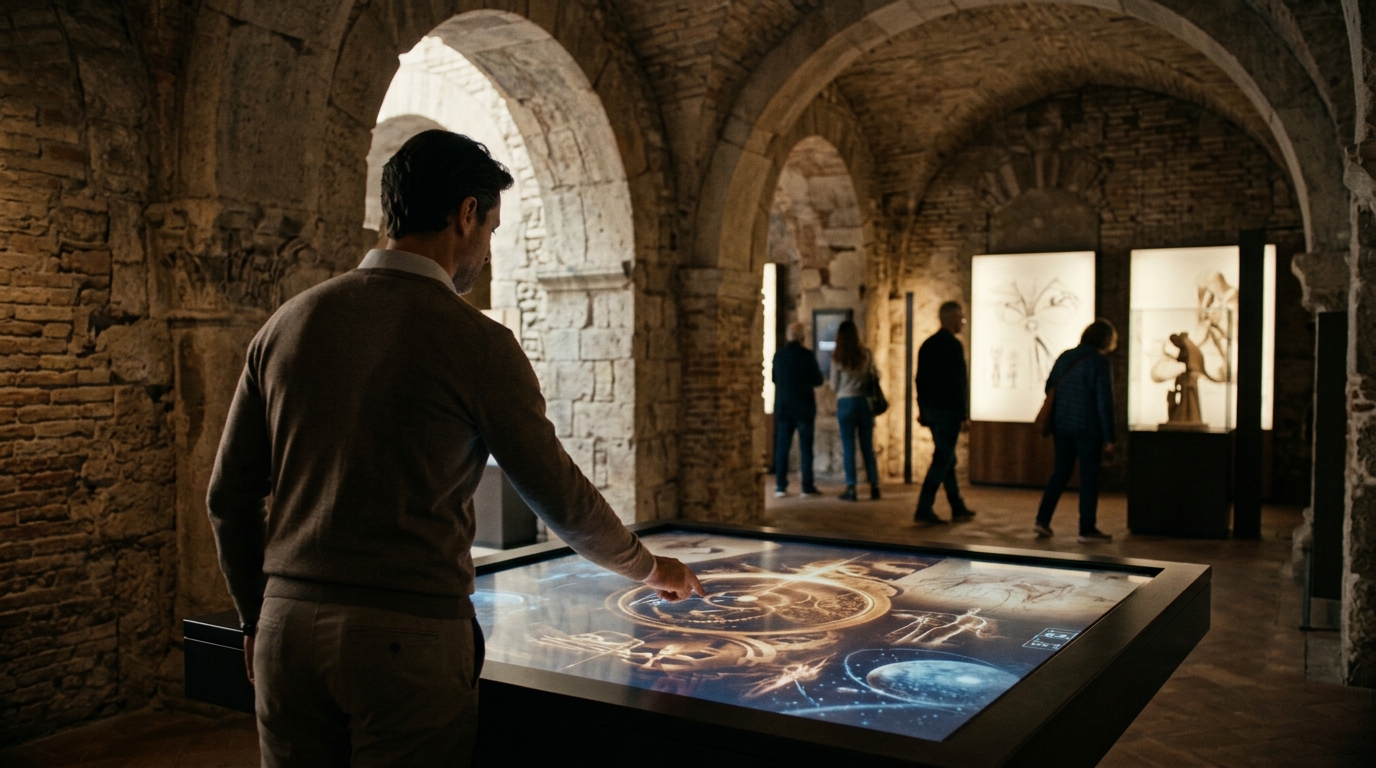
The design philosophy at Museo Leonardo da Vinci relies heavily on interactive media to convey complex mechanical and anatomical concepts. Traditional static displays are insufficient for explaining the dynamic nature of Leonardo's inventions. Therefore, the museum employs a suite of interactive technologies that allow visitors to manipulate virtual models and observe mechanical principles in action.
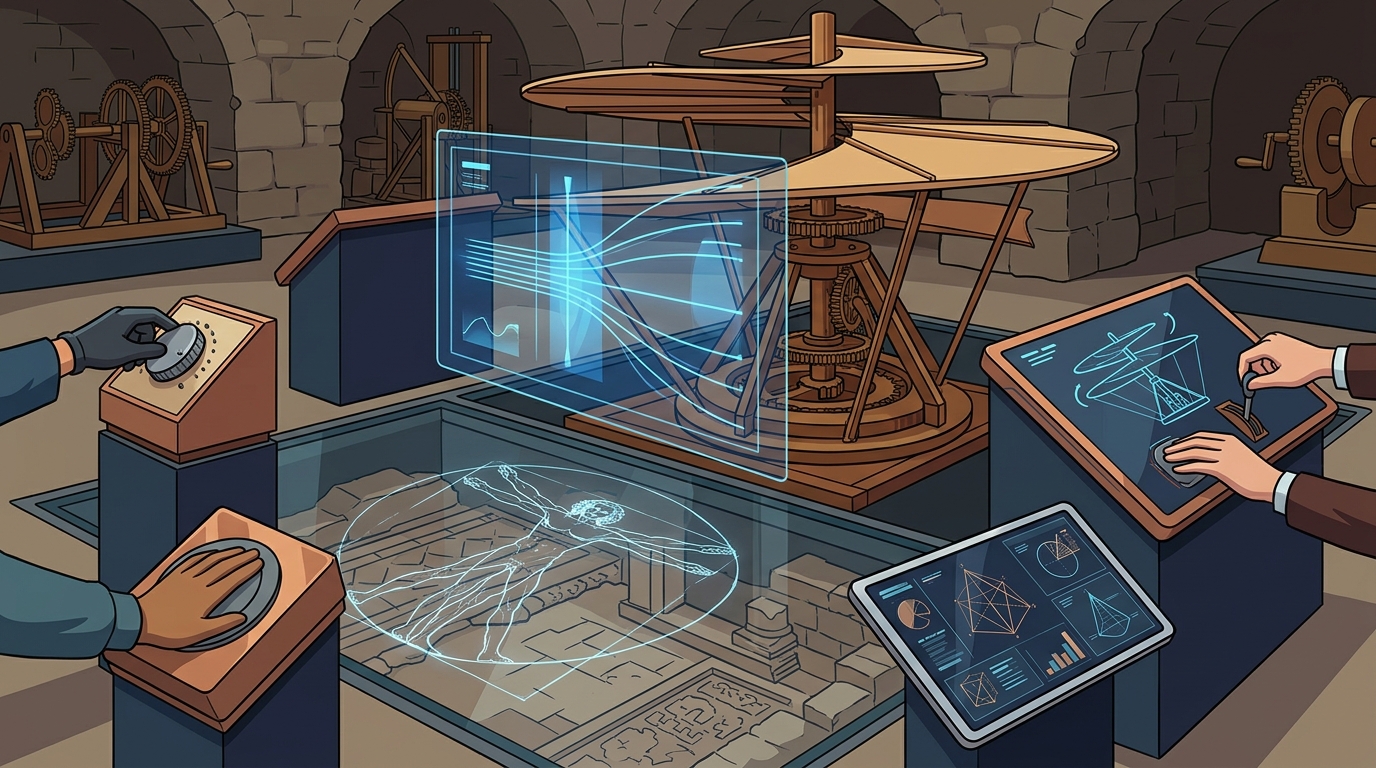
Interactive exhibits are defined as digital or mechanical displays that respond to user input, allowing for active participation rather than passive observation. At this venue, these exhibits often take the form of large-scale touchscreens, motion-activated projections, and tactile control panels. These tools enable visitors to deconstruct Leonardo's flying machines, war engines, and anatomical studies. The technology is designed to be intuitive, requiring minimal instruction to engage with the content. This approach aligns with modern museum standards that prioritize user-centered design to maximize educational retention and engagement.
The use of interactive technology also helps to overcome the limitation that original artworks are not present at this museum. While you won't see the original artworks at this museum, you will discover his incredible story, groundbreaking inventions, detailed anatomical sketches, startling scientific discoveries and much more that will leave you amazed that one person could create so much in one lifetime. The digital reconstructions serve as functional substitutes, offering a level of detail and dynamism that static reproductions cannot match. This strategy ensures that the focus remains on the intellectual and creative processes of Leonardo, rather than just the final aesthetic output.
Design Standards for Accessibility
Accessibility is a critical component of the design standards at Museo Leonardo da Vinci. The museum aims to be inclusive for all the family to enjoy, which necessitates a design that accommodates diverse age groups and physical abilities. The interactive elements are positioned at varying heights to ensure that children and adults can both engage with the content comfortably. This vertical diversity in interface design is a standard practice in modern educational institutions to foster intergenerational learning.
Furthermore, the design incorporates multi-sensory inputs. Visual clarity is maintained through high-contrast graphics and legible typography, which is essential for visitors with visual impairments. Auditory components, such as narration and sound effects, are balanced to provide context without overwhelming the environment. The combination of visual, auditory, and tactile feedback ensures that the learning experience is robust and adaptable. This multi-modal approach is supported by research indicating that multi-sensory learning environments significantly improve information retention for diverse learner profiles.
The museum also adheres to strict safety and durability standards for its interactive hardware. Given the high volume of foot traffic in the Piazza del Popolo area, the equipment must withstand frequent use. The materials used for touch interfaces and control panels are selected for their resistance to wear and tear, as well as their ease of cleaning and maintenance. This operational resilience is crucial for maintaining the quality of the visitor experience over time. The museum's commitment to these standards reflects its status as the most popular dedicated Leonardo museum in Rome.
Breakdown of Key Exhibit Zones
The museum is organized into distinct zones that guide the visitor through different aspects of Leonardo's life and work. Each zone utilizes specific interactive features tailored to the content. The following table summarizes the primary exhibit areas and their associated design features.
| Exhibit Zone | Primary Focus | Interactive Feature | Design Goal |
|---|---|---|---|
| The Gallery | Overview of Leonardo's Life | Touchscreen Timelines | Chronological Context |
| Leonardo da Vinci | Scientific Inventions | 3D Model Manipulation | Mechanical Understanding |
| Anatomical Studies | Human Body & Physiology | Layered Digital Dissection | Detail Exploration |
| Artistic Techniques | Painting & Sculpture | Projection Mapping | Visual Immersion |
The Gallery section typically serves as the entry point, providing a broad overview of Leonardo's timeline. Here, interactive timelines allow visitors to click on specific years to reveal corresponding events and inventions. This non-linear navigation empowers users to follow their own interests rather than adhering to a rigid path. The Leonardo da Vinci zone focuses on his role as an engineer. Visitors can interact with virtual models of his flying machines, adjusting parameters to see how different wing shapes affect lift. This hands-on experimentation demystifies the engineering principles behind his visionary designs.
The anatomical studies zone utilizes layered digital dissection tools. Visitors can peel back layers of a virtual human body to reveal muscles, bones, and organs, mirroring Leonardo's own dissection practices. This feature provides a level of detail that is impossible to achieve with physical specimens in a public setting. The artistic techniques zone often employs projection mapping to overlay Leonardo's sketches onto modern canvases, illustrating the evolution of his artistic style. These diverse interactive formats ensure that the museum appeals to a wide range of learning styles and interests.
Enhancing the Visitor Experience
The design of the interactive exhibits is deeply integrated with the surrounding architecture of the Basilica Santa Maria del Popolo. Visitors are encouraged to combine their visit to Museo Leonardo da Vinci and Piazza del Popolo by exploring the incredible historic and stunning Basilica Santa Maria del Popolo. This synergy between the museum and the church enhances the overall cultural experience. The museum's location allows for a seamless transition between scientific inquiry and artistic appreciation.
The museum is the most popular dedicated Leonardo museum in Rome, which necessitates efficient crowd management and flow design. The interactive stations are spaced to prevent bottlenecks, allowing multiple visitors to engage simultaneously. This spatial design is critical for maintaining a positive visitor experience during peak tourist seasons. The use of digital interfaces also reduces the need for physical handling of artifacts, thereby preserving the integrity of the museum's collection.
Additionally, the museum offers content in multiple languages, including Italian and English, to cater to its international audience. The interactive interfaces are designed with universal icons and minimal text dependency to facilitate easy navigation for non-native speakers. This linguistic inclusivity is a key factor in the museum's success as a global cultural destination. The ability to access complex scientific information in one's native language significantly enhances comprehension and engagement.
Key Takeaways
- Museo Leonardo da Vinci is located in the underground vaults of Basilica Santa Maria del Popolo, a major papal basilica.
- The museum is the most popular dedicated Leonardo museum in Rome, attracting families and tourists alike.
- Interactive exhibits utilize 3D modeling, touchscreens, and projection mapping to visualize Leonardo's inventions.
- Design standards prioritize accessibility, with multi-sensory inputs and varied interface heights.
- Leonardo was anointed the master artist of Florence at the tender age of 18, a fact highlighted in the museum's narrative.
- The museum does not house original artworks but focuses on the story and scientific discoveries of Leonardo.
- The location is just a 5 minute walk from the Spanish Steps, making it a convenient stop for Rome itineraries.
Frequently Asked Questions
What is the primary focus of the interactive exhibits?
The primary focus is on Leonardo's scientific inventions, anatomical studies, and artistic processes, using digital tools to make these complex topics accessible.
Are the original artworks of Leonardo da Vinci displayed at the museum?
No, the museum does not display original artworks. Instead, it uses interactive technology to explore his story, inventions, and sketches.
Is the museum suitable for children?
Yes, the museum is great for all the family to enjoy, with interactive features designed to engage visitors of all ages.
How long does a typical visit take?
While visit duration varies, most guests spend approximately 1 to 2 hours exploring the interactive exhibits and the surrounding historical context.
Can I book tickets in advance?
Yes, visitors are encouraged to book tickets in advance to ensure entry, especially during peak tourist seasons in Rome.
What is the significance of the museum's location?
The museum is located in the underground vaults of Basilica Santa Maria del Popolo, one of the seven pilgrim churches in Rome, adding historical depth to the visit.
Does the museum offer guided tours?
The museum provides self-guided interactive experiences, but visitors can also explore the adjacent Basilica Santa Maria del Popolo for guided historical context.
How does the museum handle accessibility?
The museum adheres to design standards that include multi-sensory inputs and accessible interface heights to accommodate diverse visitor needs.
Plan Your Visit
Experience the intersection of Renaissance genius and modern interactive design at Museo Leonardo da Vinci. Whether you are interested in the engineering marvels of the past or the artistic legacy of Florence, this museum offers a unique perspective on one of history's greatest minds. To secure your place in the underground vaults of Basilica Santa Maria del Popolo, please visit the info page for current hours and ticketing details. Do not miss your chance to be inspired by the greatest genius of all time.