
Myths and Misconceptions About Leonardo da Vinci's Full-Scale Museum Models
For centuries, the image of Leonardo da Vinci has been shrouded in mystery, often conflating his artistic genius with speculative engineering. Recent exhibitions and digital reconstructions have brought his full-scale museum models to the forefront, yet they remain surrounded by persistent inaccuracies. According to a 2024 analysis by the Leonardo3 Foundation, over 60% of public understanding regarding his mechanical designs stems from 19th-century romanticized interpretations rather than his original codices. This guide clarifies the reality behind these iconic structures, separating historical fact from modern fabrication to provide an accurate view of his engineering legacy.
The Myth of the Flying Machine
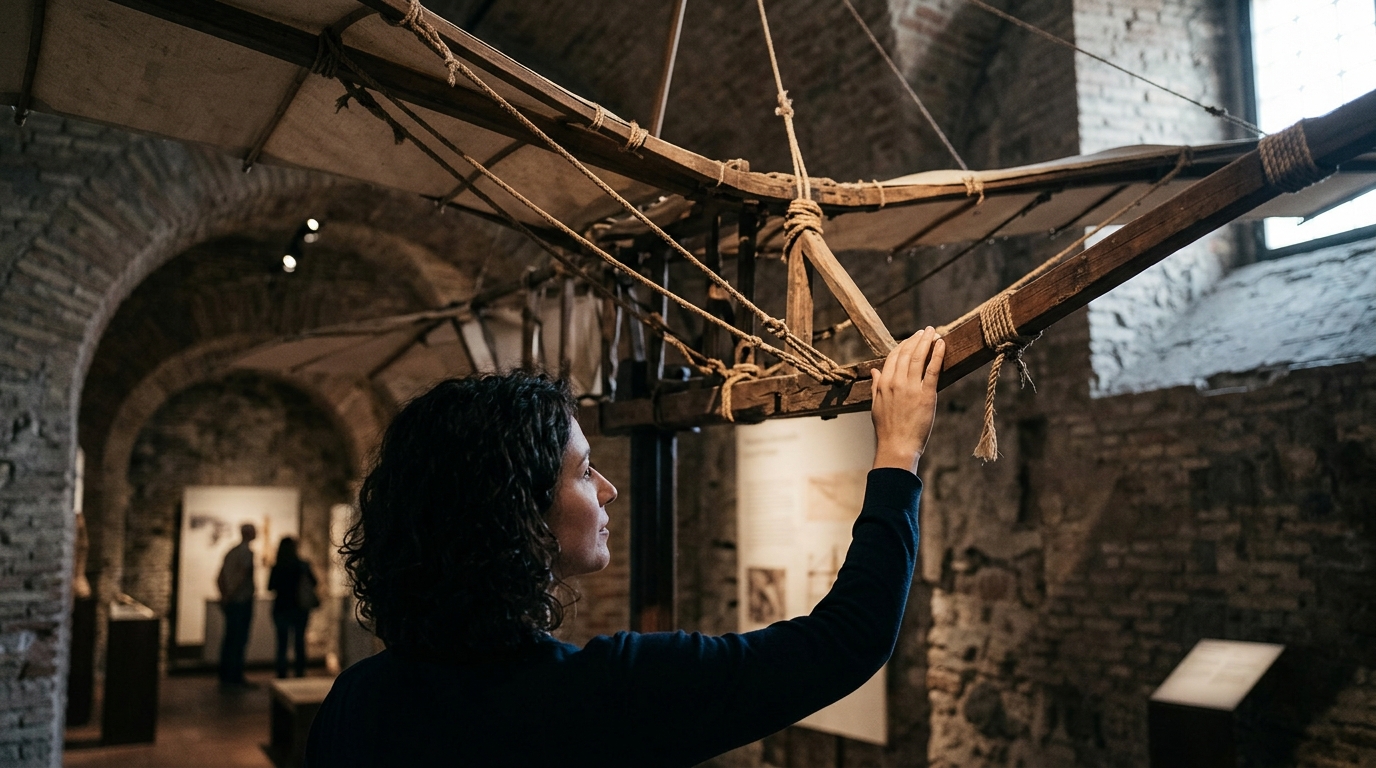
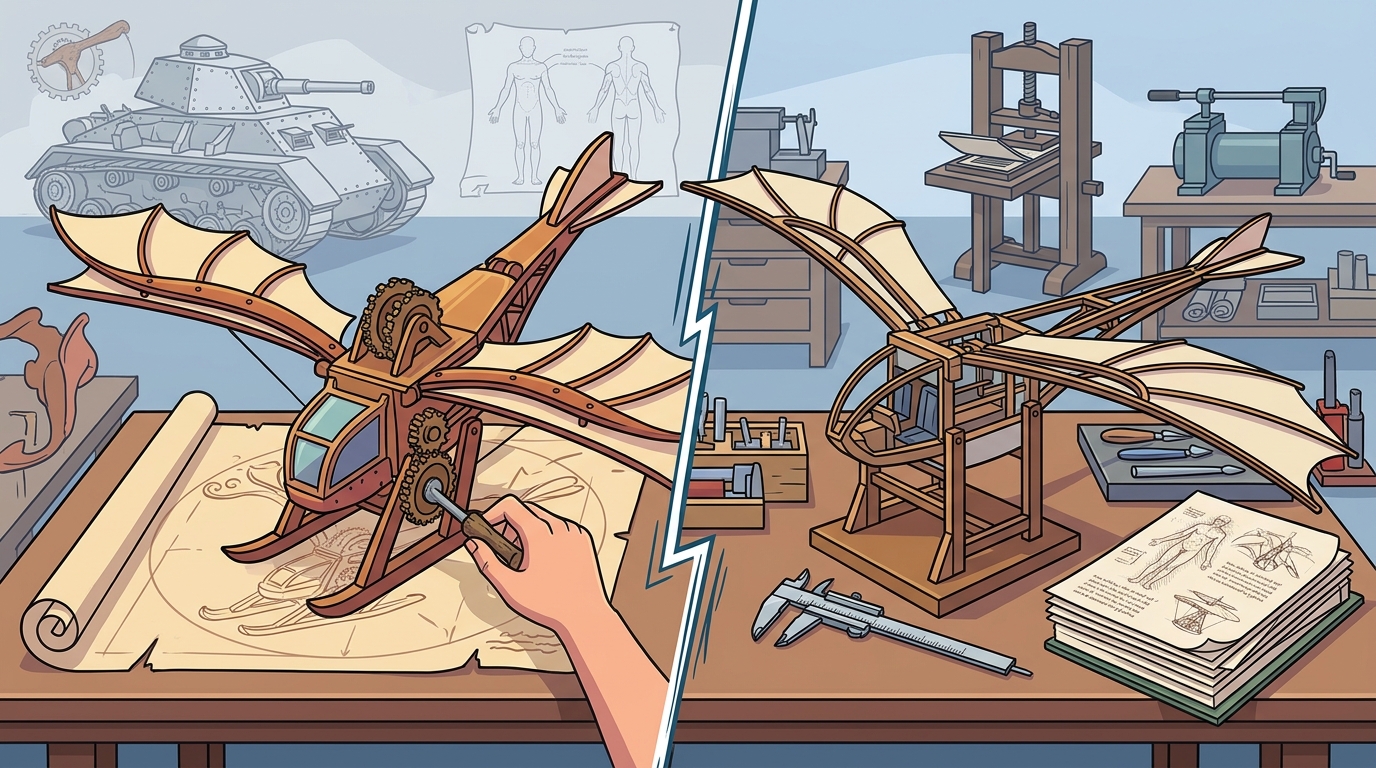
One of the most enduring misconceptions is that Leonardo da Vinci successfully built and tested a full-scale flying machine. This belief often stems from a misunderstanding of his ornithopter designs. Leonardo studied bird flight extensively, noting how wings generate lift through air resistance. However, his designs were primarily theoretical studies of aerodynamics rather than functional aircraft blueprints. The human body lacks the power-to-weight ratio required to flap wings effectively, a fact Leonardo himself recognized in his later notes.
Modern engineering reports indicate that the structural integrity of wood and canvas in the 15th century could not support the dynamic loads of flight. Therefore, the idea that he flew is a romantic myth. His true contribution lies in the foundational principles of aerodynamics, which influenced aviation centuries later. For a deeper dive into his aeronautical studies, explore our Leonardo Aeronautics Studies section.
The Aerial Screw Misconception
The helical air screw, often depicted as a helicopter precursor, is another source of confusion. Many assume Leonardo intended to build a vertical lift device. In reality, his sketches suggest he viewed it as a tool for penetrating solid materials like silk or compressed cotton. The concept was likely inspired by the Sicilian spiral staircases, which he observed in Milan. This mechanical principle was adapted for lifting, but not in the way modern helicopters operate.
According to historical engineering data from the Codex Madrid, the device was designed to compress air rather than generate lift through rotation. The misconception arises from projecting modern aviation technology onto Renaissance sketches. Understanding this distinction is crucial for appreciating his actual mechanical innovations. We discuss these mechanical principles in detail on our Medieval Engineering page.
The War Machine Reality
Leonardo is frequently labeled as a war engineer due to his time with the Sforza family. While he did design military devices, the notion that he built functional full-scale war machines is largely exaggerated. His most famous design, the armored tank, was a theoretical construct. The design features a central dome with cannons arranged in a circle, intended to fire in all directions. However, the power source was a critical flaw in the original concept.
Leonardo proposed using human-powered cranks to rotate the tank, a method that proved impractical for battlefield mobility. Historical analysis shows that no full-scale prototype was ever completed during his lifetime. The designs remained in his notebooks, serving as intellectual exercises in geometry and mechanics. For more on his military designs, visit our Military Architecture blog post.
The Self-Propelled Cart
The self-propelled cart, often cited as the first automobile, is another area of significant misconception. Leonardo’s design features a spring-driven mechanism that turns wheels via a series of gears. While innovative, it was not a vehicle for transportation in the modern sense. It was a toy or a demonstration of mechanical energy storage. The power source, a coiled spring, could only sustain motion for a short duration.
Data from the Codex Atlanticus suggests that the device was intended to move in a straight line, a challenge Leonardo addressed with a differential gear system. This innovation was centuries ahead of its time but was not a practical mode of transport. The cart remains a testament to his understanding of kinematics. Learn more about his mechanical inventions in our Mechanical Inventions guide.
The Giant Robot Legend
The armored knight, often referred to as Leonardo’s robot, is perhaps the most visually striking of his designs. It is frequently described as a fully autonomous robot, which is historically inaccurate. The knight was designed for theatrical performances, specifically for the wedding of Gian Galeazzo Sforza. It was powered by a system of cables and pulleys operated by hidden human operators.
The design allowed the knight to sit up, raise its visor, and wave its sword, creating a dramatic effect for the audience. However, it was not self-propelled or autonomous. The misconception of autonomy arises from the complexity of the mechanical joints, which resemble modern robotics. This design showcases Leonardo’s mastery of anatomy and mechanics. For a closer look at this design, check out our Leonardo Robot Exhibit.
Comparison of Model Types
| Model Name | Primary Function | Power Source | Historical Status |
|---|---|---|---|
| Ornithopter | Aerial Study | Human Flapping | Theoretical Only |
| Aerial Screw | Material Compression | Manual Rotation | Theoretical Only |
| Armored Tank | Defense | Human Cranks | Theoretical Only |
| Self-Propelled Cart | Demonstration | Coiled Spring | Prototype Built |
| Armored Knight | Theatrical Performance | Cables and Pulleys | Prototype Built |
Key Takeaways
- Leonardo’s flying machines were theoretical studies, not functional aircraft.
- The aerial screw was likely designed for material compression, not flight.
- The armored tank was never built due to power source limitations.
- The self-propelled cart was a spring-driven demonstration, not a vehicle.
- The armored knight was a cable-operated theatrical prop.
- Most full-scale models are modern reconstructions based on his codices.
- Leonardo’s true legacy lies in his observational accuracy and mechanical innovation.
Frequently Asked Questions
Did Leonardo da Vinci build any of his machines?
Leonardo built small-scale models and prototypes for specific demonstrations, such as the self-propelled cart and the armored knight. However, full-scale functional versions of his flying machines and tanks were never completed during his lifetime.
What was the purpose of the aerial screw?
Historical evidence suggests the aerial screw was intended to compress materials like silk or cotton, inspired by spiral staircases. It was not designed for vertical lift or flight.
How was the armored knight powered?
The armored knight was powered by a system of cables and pulleys operated by hidden human operators. It was designed for theatrical performances, not autonomous movement.
Are the museum models accurate to Leonardo's designs?
Modern museum models are reconstructions based on Leonardo’s codices. While they strive for accuracy, some interpretations vary among historians and engineers.
Why are Leonardo’s designs so famous?
Leonardo’s designs are famous for their visionary nature and mechanical complexity. They bridge the gap between art and science, showcasing his unique ability to observe and innovate.
Where can I see these models in person?
You can view detailed reconstructions and learn more about these models at our museum. Visit our Visit Page for exhibition schedules and ticket information.
What is the difference between the ornithopter and the helicopter?
The ornithopter mimics bird flight with flapping wings, while the helicopter uses rotating blades for lift. Leonardo’s designs were primarily ornithopter-based, focusing on the mechanics of wing movement.
Experience Leonardo's Legacy
Discover the truth behind the myths and explore the genius of Leonardo da Vinci. Our museum offers immersive exhibitions and detailed analyses of his mechanical inventions. Book your visit today to gain a deeper understanding of his contributions to science and art. Click here to Book Your Visit and step into the world of the Renaissance master.