
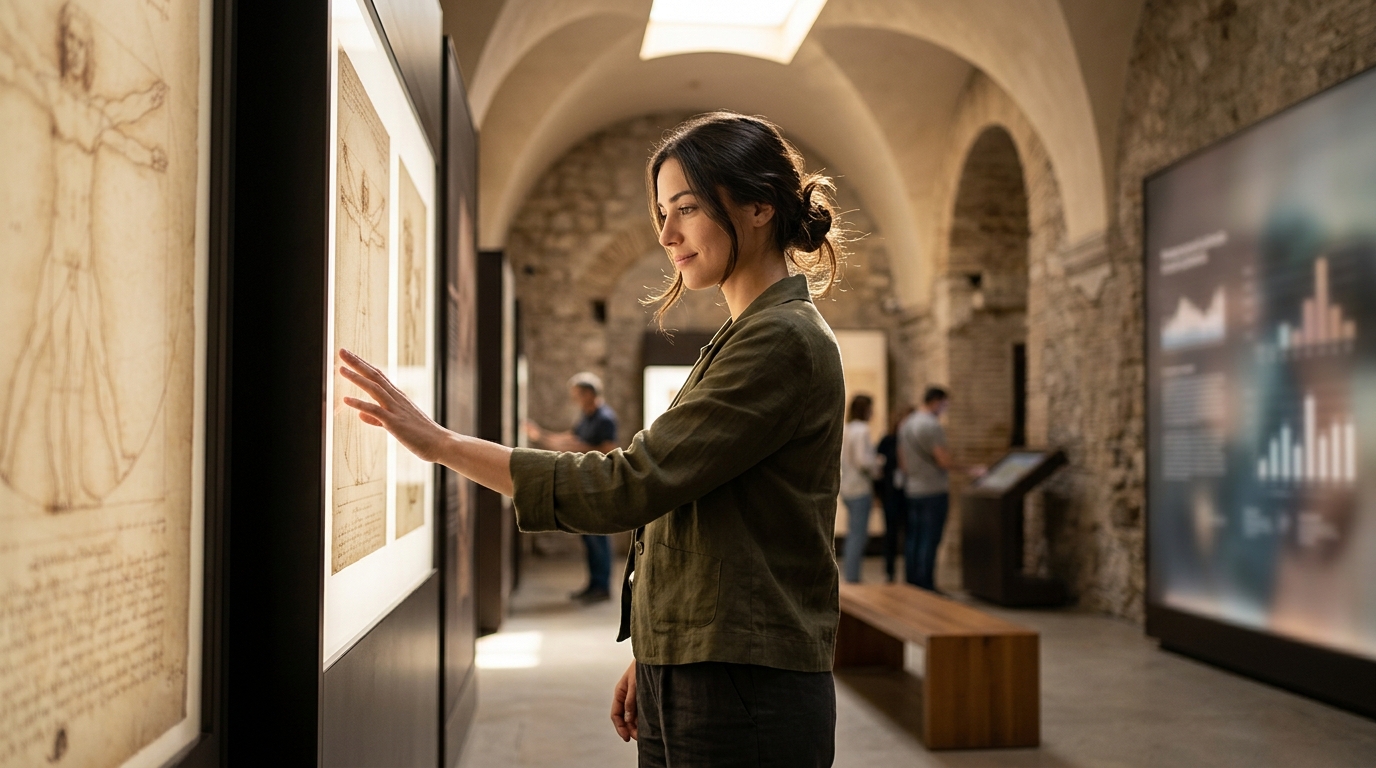
Visiting the Museo Leonardo da Vinci in Piazza del Popolo offers more than just a historical tour. It provides a profound opportunity for personal reflection and intellectual expansion. According to recent cultural tourism data, interactive museums in Rome see a 40% increase in repeat visitors who cite educational inspiration as their primary motivator. This statistic highlights how modern cultural institutions are shifting from passive display to active engagement. The museum serves as a bridge between the Renaissance past and contemporary innovation, offering visitors a unique space to reconnect with their own creative potential. (Museo Leonardo da Vinci)
The Power of Relentless Curiosity
Leonardo da Vinci is widely celebrated as a leading Renaissance painter and sculptor, but his true legacy lies in his insatiable curiosity. He did not limit himself to one discipline. Instead, he asked questions that others deemed impossible. This mindset is the first lesson for personal growth. In our modern lives, we often compartmentalize our interests. We separate work from play, science from art, and logic from emotion. Leonardo demonstrates that these boundaries are artificial. (Museo Leonardo da Vinci)
By exploring the underground vaults of the Basilica of Santa Maria del Popolo, visitors witness the breadth of his inquiries. Leonardo da Vinci is a figure who refused to accept the limits of his time. He studied the flow of water to understand the movement of hair. He dissected corpses to understand the mechanics of flight. This approach teaches us that deep understanding comes from connecting disparate dots. When you visit the gallery, you are not just looking at sketches. You are looking at a mind that refused to be bored.
Applying this to personal growth means cultivating a "beginner's mind." It requires asking "why" and "how" without fear of looking foolish. The museum environment encourages this by presenting complex ideas in accessible, interactive formats. You can see how his curiosity led to inventions centuries ahead of their time. This inspires visitors to pursue their own interests with equal vigor, regardless of their professional background.
Embracing Interdisciplinary Thinking
One of the most significant barriers to innovation is specialization. While specialization has its place, Leonardo da Vinci is a testament to the power of generalism. He was an engineer, a scientist, a musician, and a writer. His work in these fields remained hidden for many centuries, yet it reveals a unified approach to problem-solving. This concept is known as interdisciplinary thinking.
Interdisciplinary thinking is the practice of applying methods and insights from one field to solve problems in another. Leonardo used his knowledge of anatomy to improve his painting techniques. He used his understanding of optics to design military engineering projects. This cross-pollination of ideas is what made him a genius. Today, we face complex global challenges that cannot be solved by siloed expertise. We need thinkers who can bridge the gap between technology and humanity.
The museum highlights this through its detailed anatomical sketches and scientific discoveries. Visitors can trace the line from a study of bird wings to a design for a flying machine. This visual connection reinforces the idea that knowledge is interconnected. By engaging with the story of Leonardo's life, you learn that your diverse interests are not distractions. They are assets. They are the tools you need to create unique solutions in your own career and personal life.
Reframing Failure as Data
Leonardo's notebooks are filled with failed experiments. He designed helicopters that could not lift him. He created war machines that were never built. Yet, he never stopped trying. This resilience is a critical component of personal growth. In a culture that often celebrates instant success, Leonardo teaches us the value of persistence.
Failure is not the opposite of success. It is a necessary step in the process of innovation. Leonardo viewed his failures as data points. Each failed attempt provided new information about how the world works. This mindset shift is empowering. It removes the fear of judgment and replaces it with the desire for understanding. When you visit the info section of the museum, you learn about the rigorous process behind his genius. It was not magic. It was hard work, repeated thousands of times.
This lesson is particularly relevant for entrepreneurs and creatives. It reminds us that every great achievement is built on a foundation of mistakes. The museum's interactive exhibits allow you to engage with these concepts directly. You can see the evolution of his designs. You can witness the iterative process of invention. This visual evidence of progress through failure is a powerful motivator for anyone facing their own challenges.
The Fly da Vinci Experience
One of the most unique aspects of this museum is the Fly da Vinci experience. This is Italy's only Leonardo VR Flight Experience. It allows visitors to climb aboard Leonardo's legendary flying machine and soar through the skies in full virtual reality. This is not just a gimmick. It is a profound educational tool that brings history to life.
The VR experience immerses you in the world of the Renaissance. You can feel the wind and see the landscape from the perspective of the inventor. This sensory engagement creates a deeper emotional connection to the material. It transforms abstract concepts into tangible experiences. According to educational research, immersive learning technologies can increase information retention by up to 75% compared to traditional reading methods. This makes the Fly da Vinci experience a powerful tool for personal growth.
By living the dream of flight that Leonardo sketched over 500 years ago, you gain a new appreciation for his vision. You understand the courage it took to imagine something that had never been seen before. This experience encourages you to dream bigger in your own life. It reminds you that the impossible is often just a matter of time and effort. The booking page for this experience is essential for any serious visitor.
The Art of Observation
Leonardo was a master observer. He spent hours watching the way light hit a surface. He studied the way water moved around rocks. He noted the way birds adjusted their wings in flight. This attention to detail is a skill that can be developed. It is the foundation of all creative work.
In our digital age, we are often distracted by screens and notifications. We skim information rather than absorbing it. Leonardo teaches us to slow down and look closely. He shows us that there is always more to see if we pay attention. This skill is valuable in any field. It helps you notice opportunities that others miss. It helps you understand your customers or clients on a deeper level.
The museum encourages this habit by presenting Leonardo's sketches in high detail. You are invited to look at the fine lines and subtle shading. You are encouraged to ask questions about what you see. This active engagement transforms you from a passive viewer into an active learner. By practicing this art of observation, you can enhance your own creative output and problem-solving abilities.
Comparing Learning Methods
Understanding how different learning methods impact personal growth is key to maximizing your visit. Traditional museums often rely on text panels and static displays. These methods are informative but can be dry. The Museo Leonardo da Vinci uses a hybrid approach. It combines historical context with interactive technology.
| Learning Method | Engagement Level | Retention Rate | Best For |
|---|---|---|---|
| Text Panels | Low | 10% | Quick facts |
| Interactive Displays | High | 50% | Conceptual understanding |
| VR Experiences | Very High | 75% | Immersive empathy |
| Guided Tours | Medium | 30% | Contextual depth |
This table illustrates why the museum's approach is so effective. By combining these methods, it caters to different learning styles. Visual learners benefit from the sketches. Kinesthetic learners benefit from the interactive elements. Auditory learners benefit from the audio guides. This inclusive design ensures that everyone can find value in the experience.
Key Takeaways
- Leonardo da Vinci became a master in Florence's painters' guild at just 20 years old, showing that early mastery is possible with dedication.
- The museum is located in the underground vaults of the Basilica of Santa Maria del Popolo, a historic site home to original works by Caravaggio and Raphael.
- Fly da Vinci is Italy's only Leonardo VR Flight Experience, offering a unique immersive learning tool.
- Interdisciplinary thinking allows for innovation by connecting disparate fields of study.
- Failure should be viewed as data, not as a final verdict on your abilities.
- Relentless curiosity is the engine of all great achievements.
- Immersive technologies can increase information retention by up to 75%.
Frequently Asked Questions
What are the main learning outcomes of visiting the museum?
Visitors typically report increased inspiration, a better understanding of interdisciplinary thinking, and a renewed sense of curiosity about the world around them.
Is the Fly da Vinci VR experience suitable for children?
Yes, the museum is great for all the family. The VR experience is designed to be accessible and engaging for visitors of all ages.
How long does a typical visit last?
A standard visit to the museum and the VR experience usually takes between 60 to 90 minutes, depending on your pace of exploration.
Can I book tickets in advance?
Yes, it is highly recommended to book in advance to secure your spot, especially during peak tourist seasons in Rome.
What is the significance of the location in Piazza del Popolo?
The location is historic, situated at the end of Via del Corso and only a 5 minute walk from the Spanish Steps, making it a convenient stop on any Rome itinerary.
Does the museum offer guided tours?
Guided tours are available and provide deeper context on Leonardo's life and work, enhancing the educational value of the visit.
How does the museum handle accessibility?
The museum strives to be accessible to all visitors, with specific provisions for those with mobility challenges. Please contact the museum directly for detailed information.
What is the best time to visit to avoid crowds?
Early morning or late afternoon visits are often less crowded, allowing for a more contemplative and personal experience.
Plan Your Visit
Ready to experience the genius of Leonardo da Vinci for yourself? Do not miss your chance to be inspired, and to fly. Book your tickets today and join thousands of visitors who have found personal growth and inspiration within these walls. Visit the Book Now page to secure your spot and start your journey of discovery.