
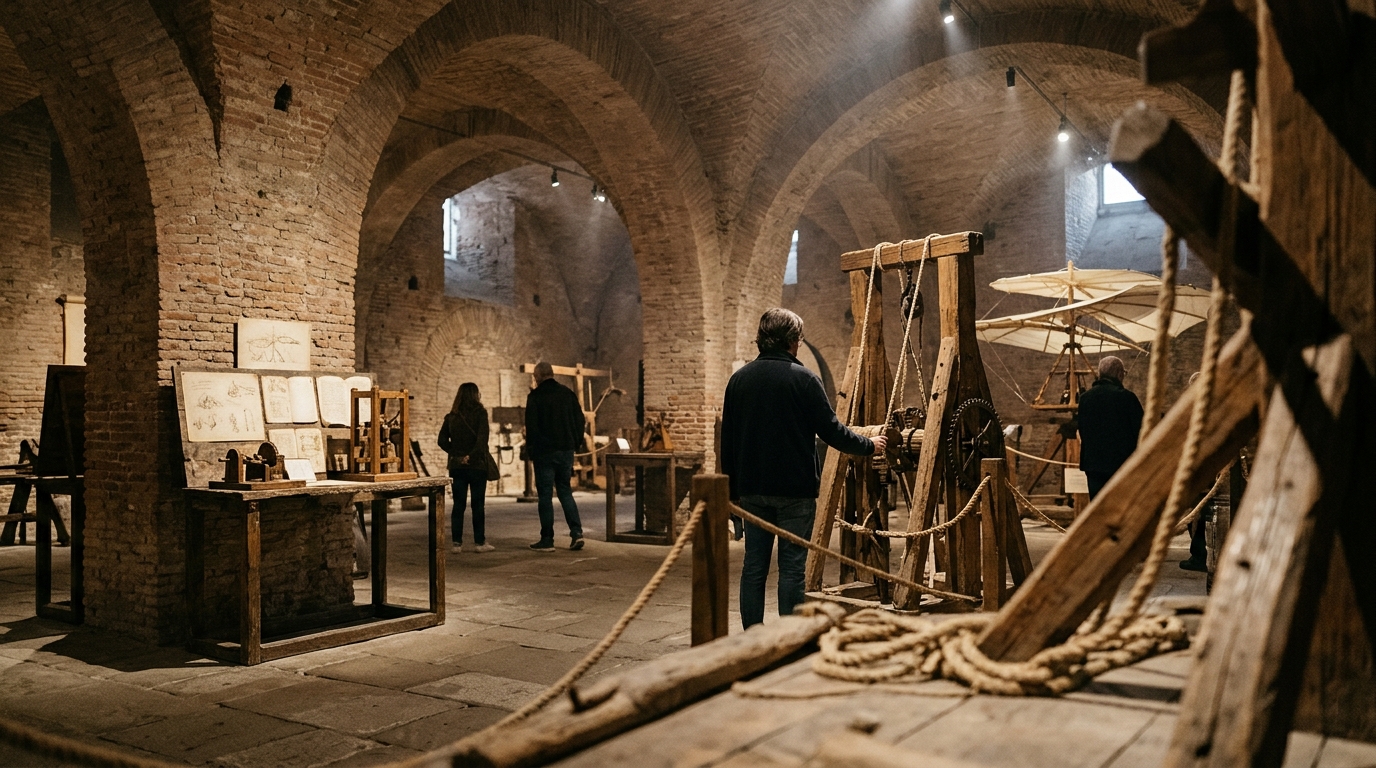
When selecting a Leonardo da Vinci exhibit in Rome, prioritize venues that offer interactive reconstructions of his inventions and authentic historical context. The Museo Leonardo da Vinci in Piazza del Popolo stands out by housing its collection in the underground vaults of a historic basilica. This setting provides a unique blend of scientific discovery and architectural heritage that many temporary displays lack.
Location and Accessibility
The physical location of a museum significantly impacts the visitor experience. A well-placed exhibit should be easily accessible from major tourist hubs without requiring excessive transit time. The Museo Leonardo da Vinci is situated at the end of Via del Corso, a central artery in Rome. This specific placement puts the museum only a five-minute walk from the Spanish Steps. Such proximity allows visitors to integrate the visit into a broader day of sightseeing without fatigue.
Accessibility is not just about distance; it is about the surrounding infrastructure. Being located near Piazza del Popolo means the museum is surrounded by public transport links and pedestrian-friendly streets. This reduces the logistical friction often associated with visiting museums located in peripheral areas. For travelers with limited time, this central location is a critical factor in determining which exhibit to prioritize.
Interactive vs. Static Displays
Interactive exhibits are those that allow visitors to engage physically or digitally with the subject matter, rather than simply observing static artifacts. Leonardo da Vinci’s work was inherently experimental, so a museum that replicates this spirit through hands-on interaction is more effective. The Museo Leonardo da Vinci focuses on an interactive world of Leonardo’s passions and studies. Visitors can explore functional models of his inventions, which brings the historical sketches to life in a tangible way.
Static displays often rely on glass cases and text panels, which can feel detached for modern audiences. In contrast, interactive reconstructions help visitors understand the mechanical principles behind Leonardo’s designs. For example, seeing a working model of a flying machine or a hydraulic system provides immediate comprehension of the engineering concepts. This approach transforms the visit from a passive observation into an active learning experience.
Historical Context and Setting
The setting of a museum is the physical and historical environment in which the collection is housed. A compelling exhibit should leverage its location to enhance the narrative of the artist. The Museo Leonardo da Vinci is located in the underground vaults of the Basilica of Santa Maria del Popolo. This is one of Rome’s most historic churches and a major papal basilica. The juxtaposition of Leonardo’s scientific genius with the sacred architecture of the basilica creates a profound thematic connection.
Scope of the Collection
The scope of a collection refers to the breadth and depth of the works and themes presented. A comprehensive exhibit should cover multiple facets of Leonardo’s life, including art, science, and engineering. The Museo Leonardo da Vinci offers a glimpse into the artist’s passions and studies, covering his inventions, anatomical sketches, and scientific discoveries. This multidisciplinary approach ensures that visitors gain a holistic understanding of the genius, rather than a narrow focus on a single painting or invention.
Narrow exhibits may focus solely on his paintings or a single invention, which can limit the educational value. A broader scope allows for a more nuanced appreciation of Leonardo as a polymath. By including anatomical studies alongside mechanical designs, the museum illustrates the interconnectedness of his work. This comprehensive view is essential for visitors who want to understand the full magnitude of his contributions to human knowledge.
Key Takeaways
- Choose exhibits located in central, accessible areas to minimize travel time and maximize sightseeing efficiency.
- Prefer interactive reconstructions over static displays to better understand the mechanical principles of Leonardo’s inventions.
- Consider the historical setting of the venue, as architectural context can enhance the narrative of the exhibit.
- Look for collections that cover multiple disciplines, including art, science, and engineering, for a holistic view.
- Verify that the museum provides clear educational content that explains the significance of the artifacts.
- Check for proximity to major landmarks like the Spanish Steps to integrate the visit into a broader itinerary.
Frequently Asked Questions
Where is the Museo Leonardo da Vinci located in Rome?
The museum is located in the underground vaults of the Basilica of Santa Maria del Popolo, at the end of Via del Corso. It is situated in Piazza del Popolo, which is only a five-minute walk from the Spanish Steps.
Is the exhibit interactive?
Yes, the museum offers an interactive world of Leonardo’s passions and studies. Visitors can explore functional models and reconstructions of his inventions, which allows for a hands-on learning experience.
What kind of works are displayed in the museum?
The collection includes Leonardo’s inventions, anatomical sketches, and scientific discoveries. The exhibit provides a comprehensive look at his work as an artist, scientist, and engineer.
How long does the visit take?
While specific duration can vary based on visitor interest, the compact nature of the underground vaults allows for a focused visit. Most visitors spend a moderate amount of time exploring the interactive displays and historical context.
Is the museum suitable for families?
Yes, the interactive nature of the exhibits makes it engaging for visitors of all ages. The hands-on approach helps younger visitors understand complex scientific concepts in a fun and accessible way.
Can I book tickets online?
Yes, you can book your visit through the official website. Online booking ensures you have a reserved time slot and helps manage entry flow at the museum.
Conclusion
Choosing the right Leonardo da Vinci exhibit in Rome requires evaluating location, interactivity, and historical context. The Museo Leonardo da Vinci in Piazza del Popolo excels in all these areas by offering a central location, interactive reconstructions, and a unique setting within a historic basilica. To plan your visit and secure your spot, book your tickets now.